

Colour is such a subjective matter; what’s your favourite? I like purple but my friend can’t bear it; my daughter loves brown, but I’m with Winston Churchill there: “I cannot pretend to be impartial about the colours. I rejoice with the brilliant ones, and am genuinely sorry for the poor browns“. When it comes to gemstones, the question of colour should not be subjective; unfortunately, it very often is. All gemstones will have a top colour; the most-prized shade within each stone’s shade range that commands top dollar. For example, in tanzanite it’s a pure blue similar to sapphire. In emerald it’s a bluish-green to green with strong to vivid saturation and medium to medium-dark tone. This may not be your preferred shade – for example I am more fond of the more violet tanzanites – but it is simply the one that will command the highest price. With a stone like tanzanite, which is highly pleochroic, cutters must often decide whether to cut a larger stone that is not oriented for top colour, or a smaller one that is.
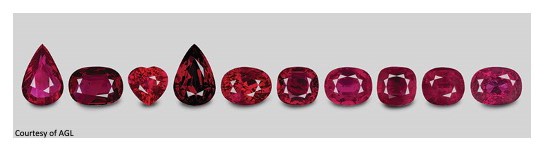
The problem is, this is by no means straightforward. Over the years, trade and commercial names have arisen to describe top colour. Most of these will have their roots in something quite meaningful and specific, but because the names themselves are not specific, it gives sellers a great deal of leeway to include a huge variety of shades until the name becomes practically meaningless. Ruby is a really good example; the term ‘pigeons’ blood’ has for years been the gold standard in terms of colour. It’s meant to refer to stones with a glowing red fluorescence, but just look at the shade range as illustrated in this AGL photograph. A 2015 study examined 500 rubies on just one trading network with 90% described as ‘pigeons’ blood’. But with per carat prices ranging from $450 to $50,000, the description is meaningless. In fact the term that the GIA use is ‘fanciful’.
Sapphire is another good example: Kashmir sapphire is the gold standard, which is traditionally a violet to violet-blue stone with high saturation and a velvety lustre; Ceylon sapphires are traditionally lighter with higher lustre. Australian stones tend to be more green with a darker tone. The obvious problem here is that not all stones from these locations will exhibit these properties and stones that do, aren’t necessarily from these locations. It’s also very difficult to know, once a stone has been dug out of the ground, where it has come from, so you could be paying top dollar for Kashmir sapphire with no actual proof that’s what it is. Sellers will offer mixed bags of dark sapphires to their wholesale clients that might be from a mix of locations – Nigeria, Vietnam, China, Thailand, Australia and label them as ‘Australian’ and this is more acceptable as these are much lower value and the deposits are very similar.
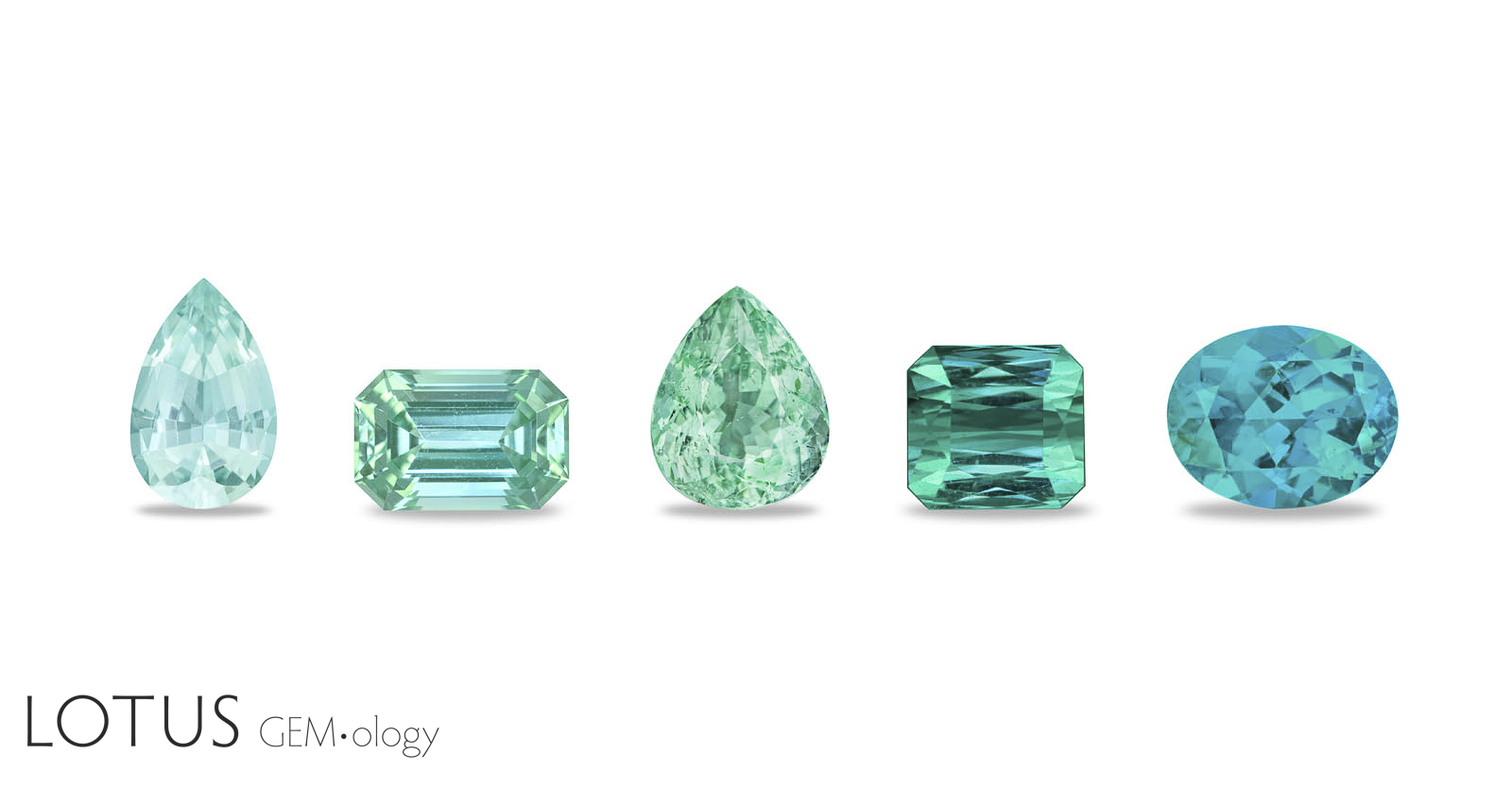
Paraiba tourmaline is another example. Coloured by copper, these stones are extraordinary, neon aqua stones (sometimes described as ‘Windex’!). They were discovered relatively recently, in 1982 and found only in Brazil, named for the province where they were found. Whilst subsequent deposits of copper bearing ore was found in Mozambique and Nigeria, most stones did not approach the extraordinary saturation and hue of the Brazilian stones. But have a little look on ebay; go on, put ‘paraiba tourmaline’ into the search box and what comes up is anything with the slightest aqua hue, from watery pale greens and light blues. In the picture below (courtesy of Lotus Gemology), from left to right, all of these would appear to qualify as paraiba, but only two of them owe their colour primarily to copper (stones 3 and 5 working from left to right). They appear almost identical and all equally breathtaking, but the term Pariaba will cause the price to skyrocket.
Other forms of tourmaline are equally poorly defined – slap the word chrome or rubellite on the front of it and you’ve got a nice price hike, but the definition appears to be tourmaline that’s quite bright green and tourmaline that’s very bright pink – and many chrome tourmaline stones are actually coloured by vanadium!
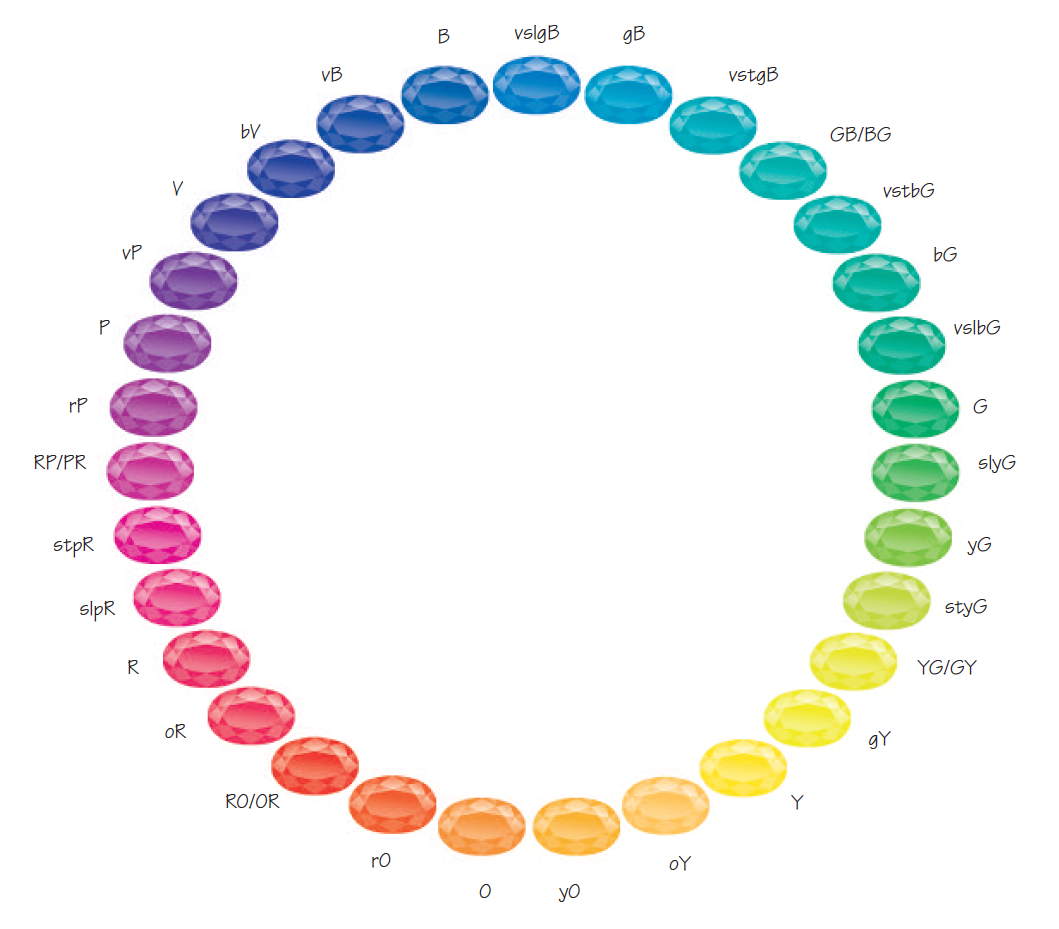
The GIA has long sought to take the flights of fancy out of colour description and has developed a system of colour classification that relies on extremely fine shade distinction and a very objective language: for example, colours run from, say, very strong blue-green to blue green, to very slightly blue-green, to green, and so on. These colour definitions allow a really accurate description and are anchored to a colour chart (see below, courtesy of GIA). What this method lacks in romance it does make up for in accuracy and it does something else as well; it restricts the colour solely to a gemstone’s hue.
What do I mean by that? A gemstone is not merely red, blue, green. That is its hue, and it does matter; it plays a big part in the value. But there are other factors which are also very important in a stone’s value; in fact you could say the colour exists in three dimensions. Hue is one, but equally important are saturation and tone: how intense is the colour and how dark? The GIA deals with these separately for example a Kashmir sapphire can be operationalised as violetish blue to pure blue hue, with moderately strong to vivid saturation and medium-dark tone. Each aspect is described separately. Another problem with trade or commercial names is that they often only refer to hue, and so they tend to elevate hue above all other colour aspects; in reality a stone’s value is based on a combination of hue, saturation and tone. In addition to this, a stone may display colour zoning or pleochroism; it may have inclusions, it may appear a different colour under different types of light, and let’s not forget about cut. This can also affect the appearance of colour, not just in terms of how the stone is oriented but a stone cut to save weight will not return light to the eye in the same way as one cut to ideal dimensions and may appear dark, or have dead areas. It’s a good idea to have a solid handle on colour and value, as traders will always favour those inconsistent and ill-defined colour names over more precise definitions as it allows for a much wider range of stones to be funnelled into the top price brackets. As with everything in this business, a little bit of knowledge goes a long way and caveat emptor!
joopygems.com


 Joopy Gems | The Blog