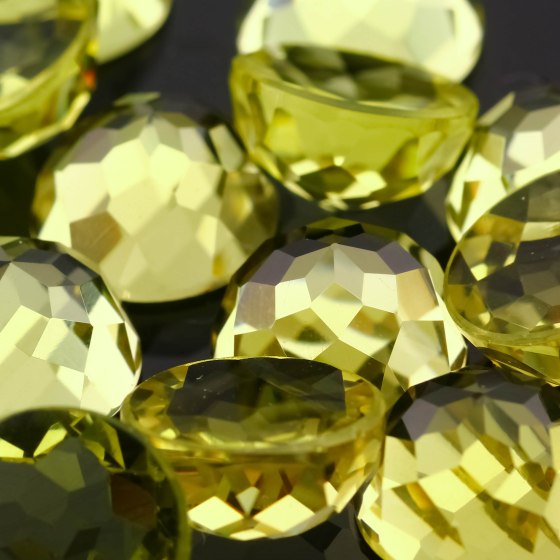
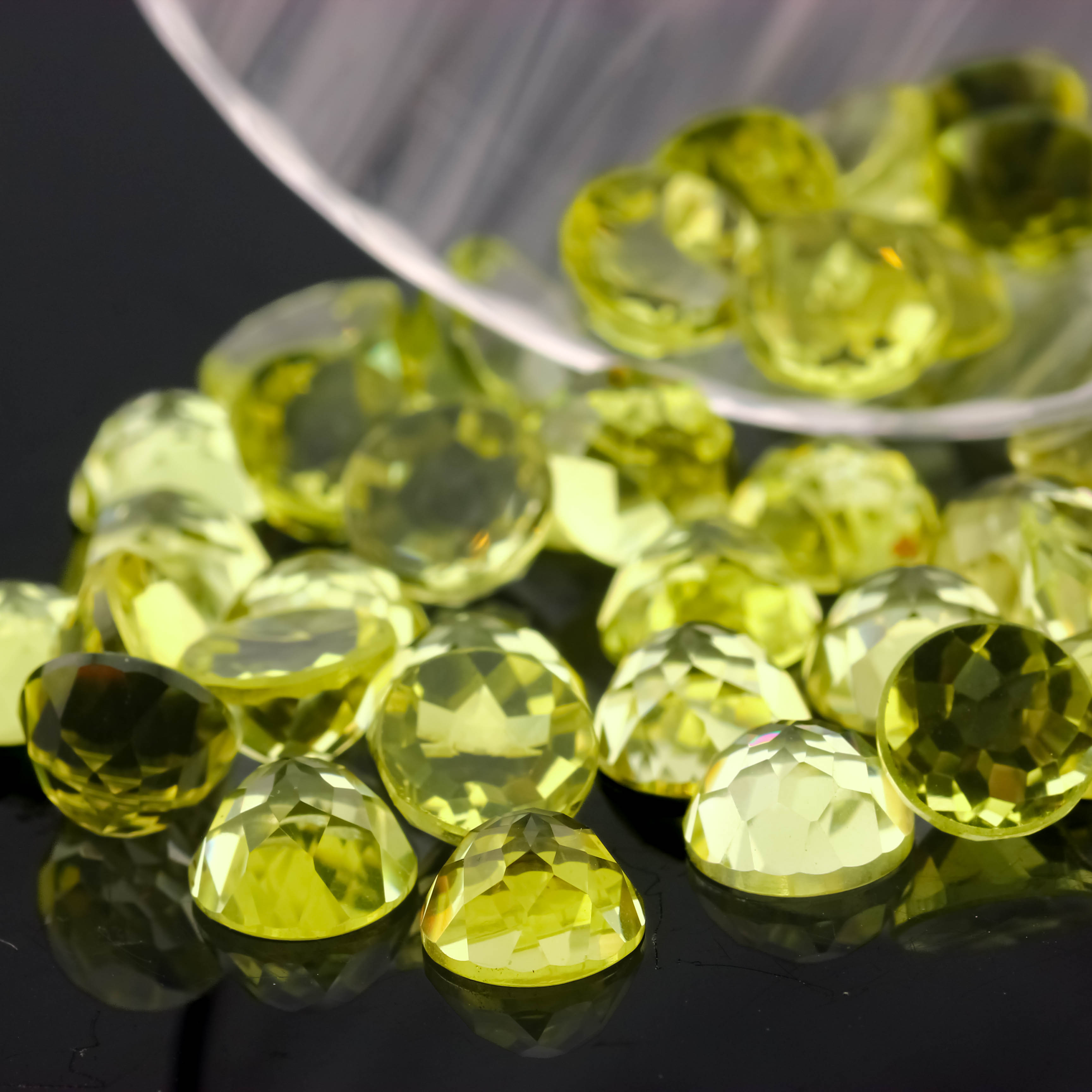
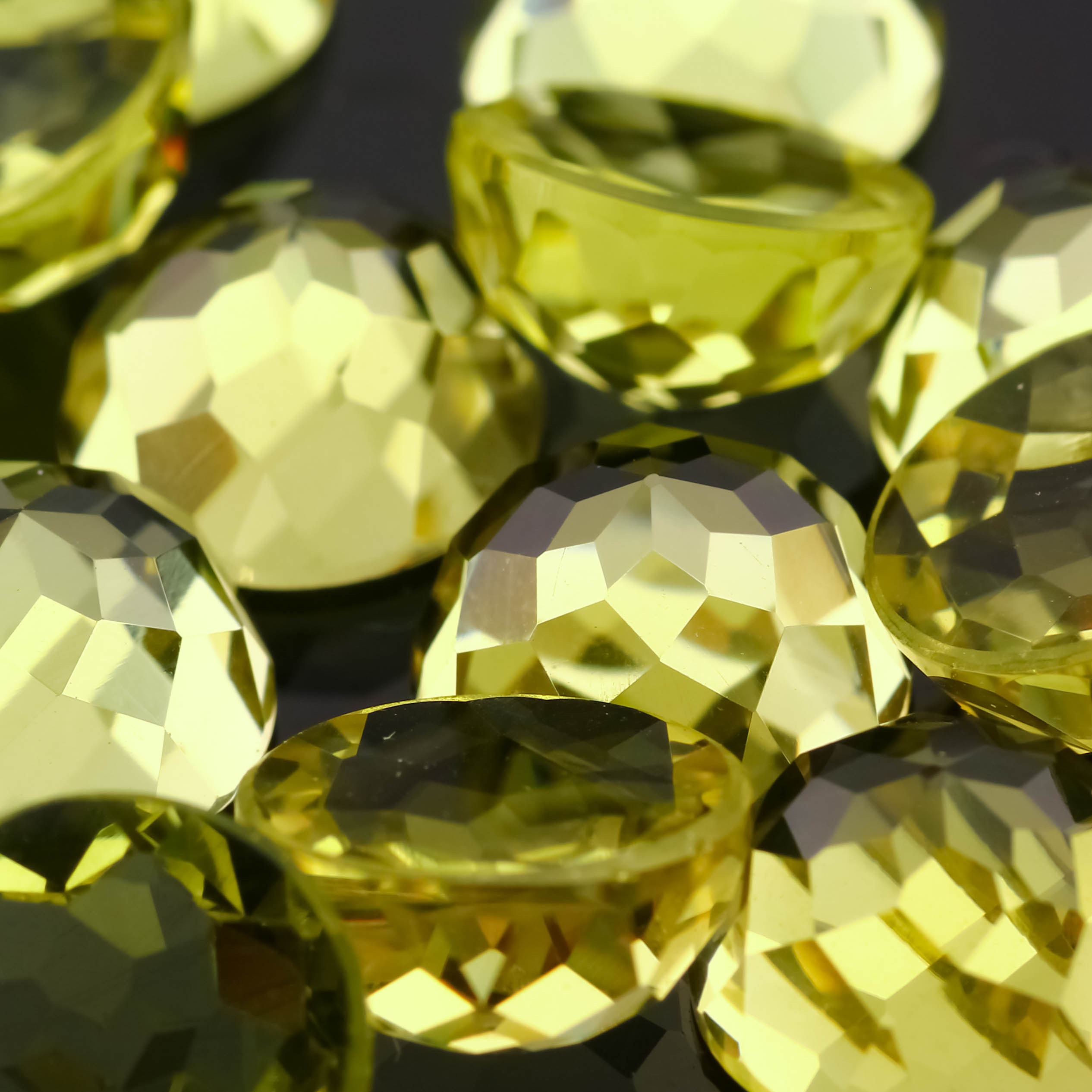
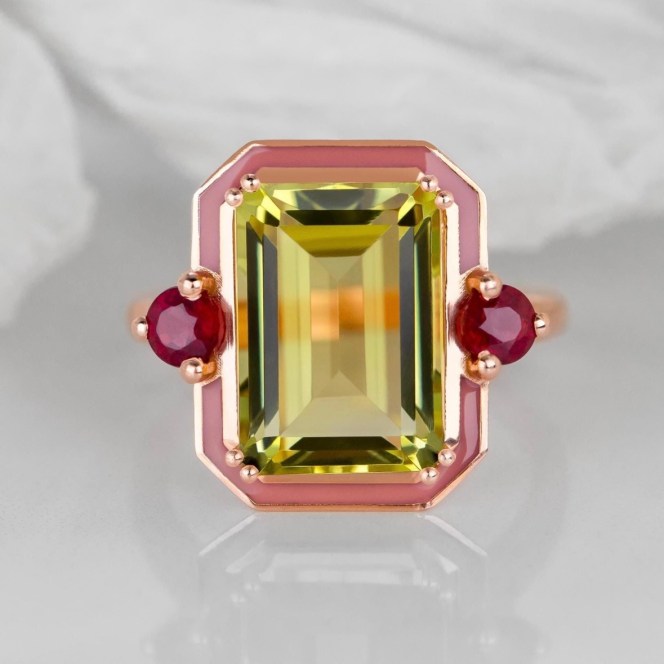
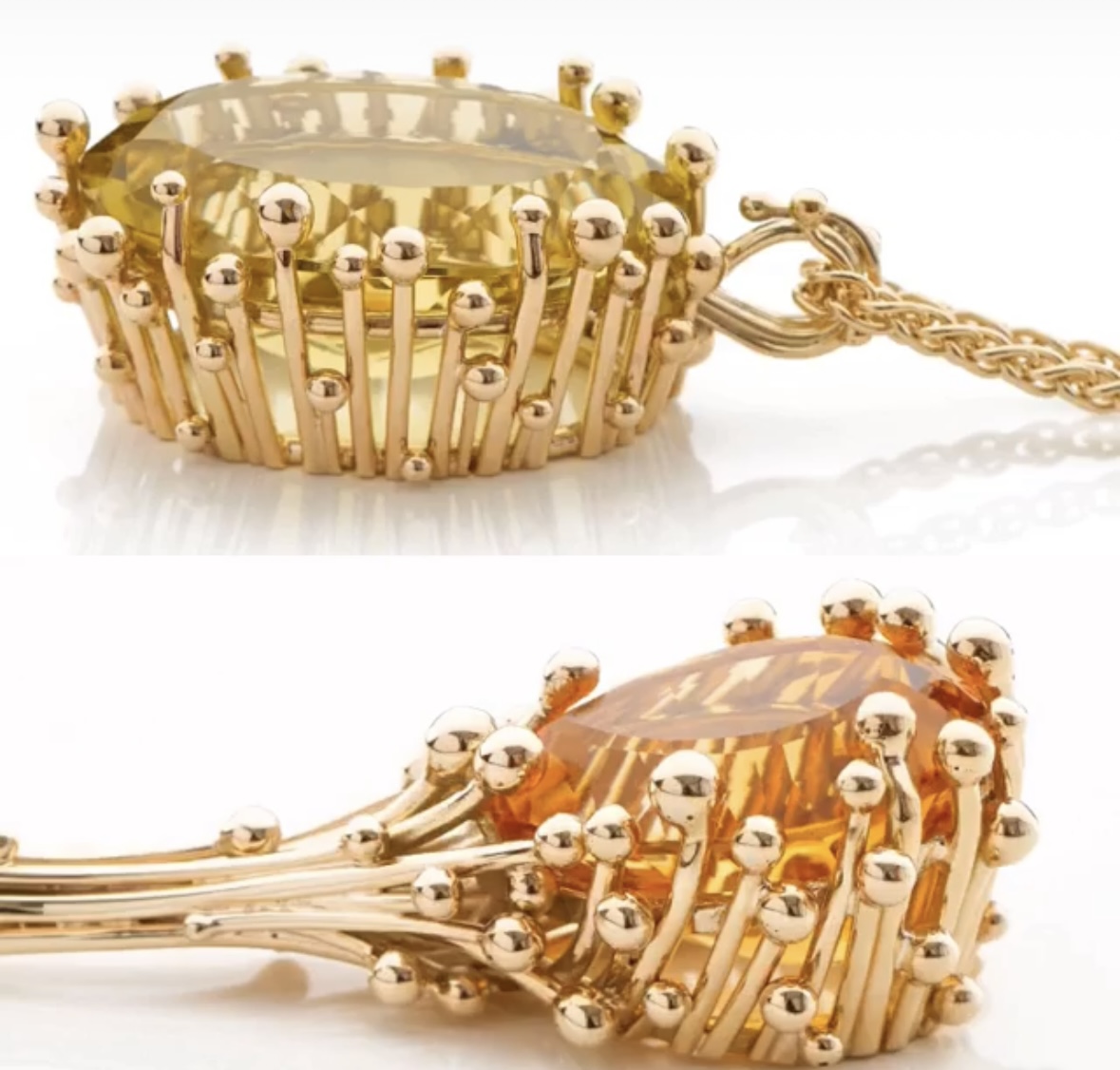
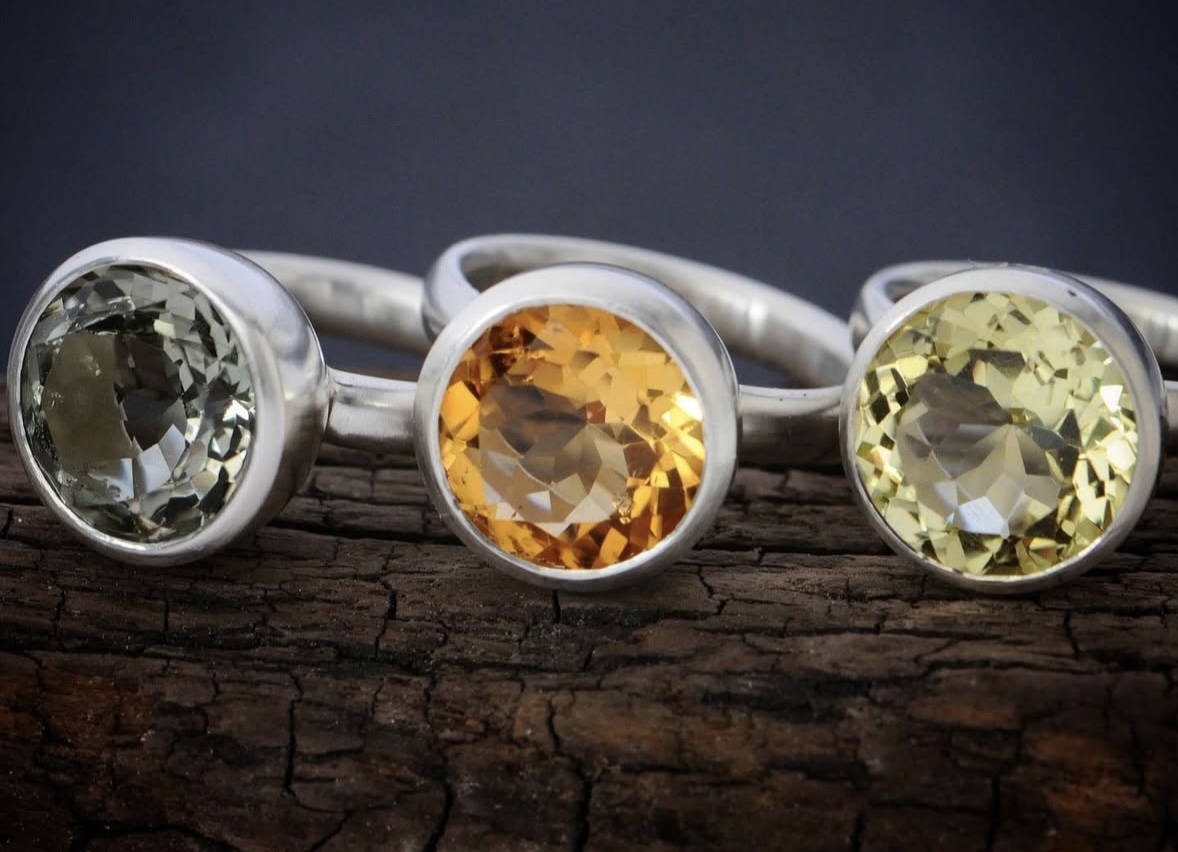
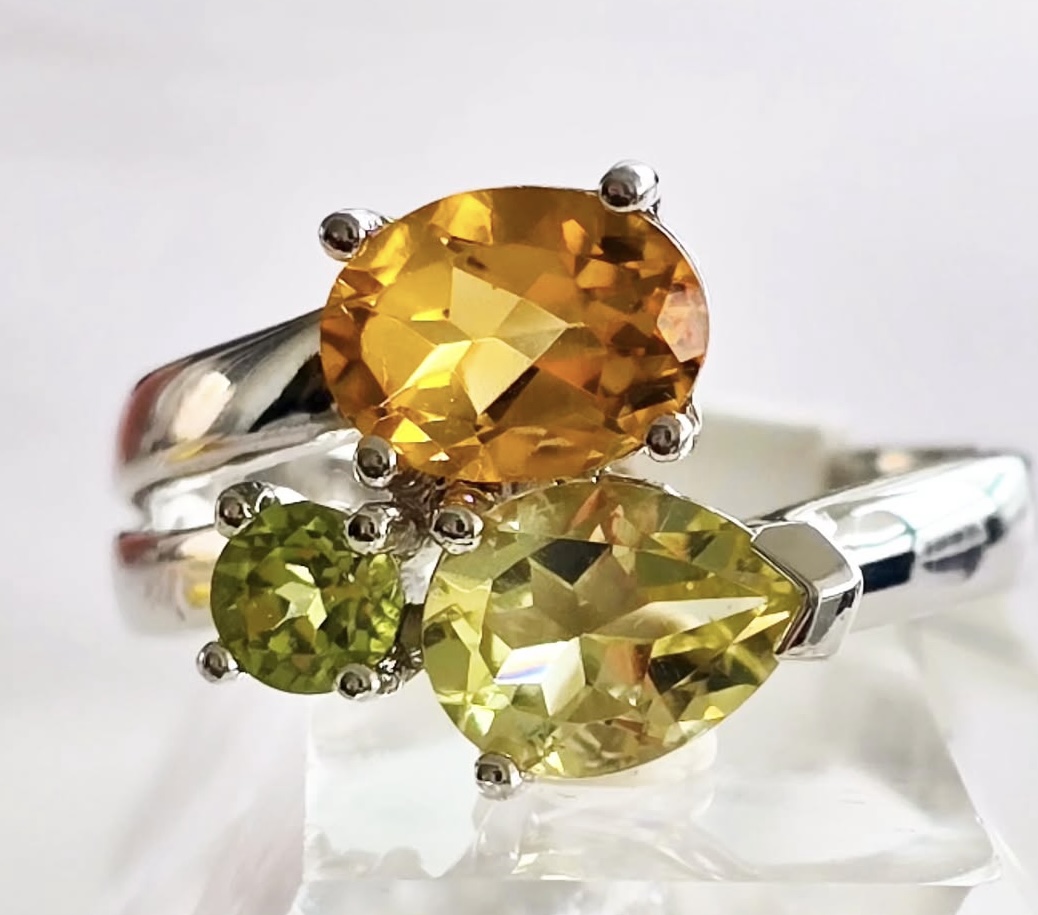
Quartz is one of the most ubiquitous gemstones; whether amethyst, citrine, rose, smoky or lemon, it’s plentiful and reasonably priced and you’re not going to have to part with a limb to buy it. It comes in so many different colours, including the fascinating and beautiful rutilated varieties. I want to talk a bit about lemon quartz, as it’s one of the family of treated quartzes and is a bit of an unsung hero. It’s a stone that cuts and polishes nicely and you can have it in pretty large sizes due to the relatively low carat price. Whiskey quartz, lemon quartz; nice lustrous stones in good sizes. Lemon quartz is irradiated with cobalt 60 gamma rays at very low dose (the stones aren’t glowing!) and then heated. The other thing that people aren’t generally aware of is that comes in different intensities of colour – and I don’t just mean that bigger stones are more saturated; you can get it from pale to much more intense yellow-green. My supplier tells me that people use it as a substitute for peridot, but I don’t think it’s that dark. It is on the same fresh, citric yellow-green spectrum, however. I used to sell mine – which is darker than standard lemon quartz – as green-gold quartz, to differentiate it, but it was too much of a differentiation, as people didn’t know what I was talking about and after I got asked a few times if I stocked lemon quartz, just changed the title! But it does have good saturation and is more of a yellow-green than pale yellow; I think you need it with a bit of saturation otherwise it looks a bit wan. The colour is more like a chrysoberyl and I think it really comes into its own when it’s mixed with other gemstones. I love the combination with citrine, which you would think would be a clash; the warm gold and the cool lemon, but it works. I also absolutely love it with the ruby, and I never would have thought about pairing these two, but they look amazing. In fact, I think I do like this stone best when it’s warmed up with gold, or golden stones, as they just seem to make it glow.
I haven’t done a newsletter for a while, but now, this November I have some new London blue to report, as well as restocks or white topaz in 6mm and 8mm. The London blue is priced very keenly and going fast, so hop on over to my newsletter or my website to see exactly what we have on offer! Also the usual round up of news and events going on in the gem world!
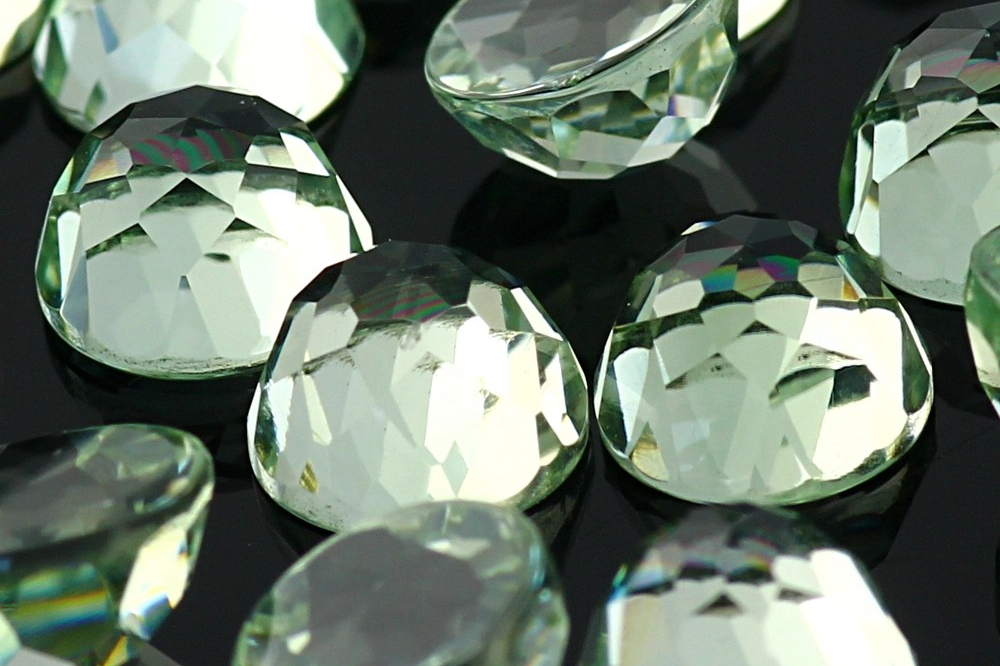
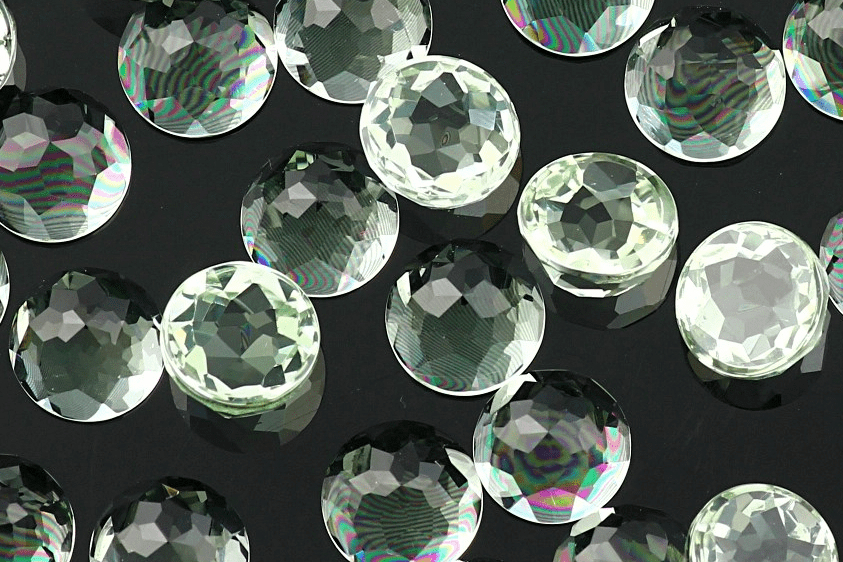
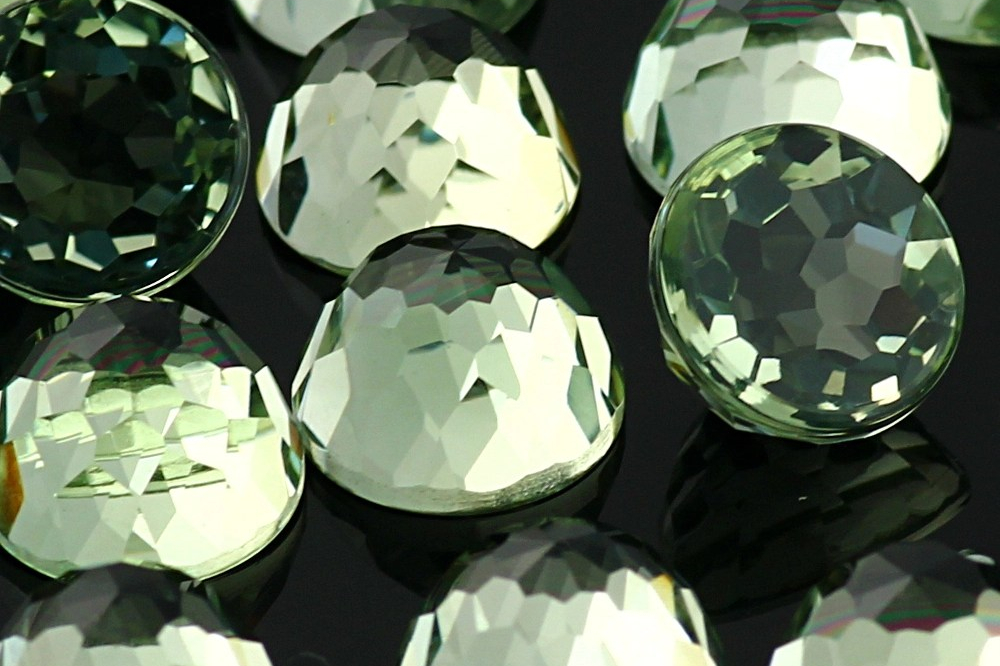
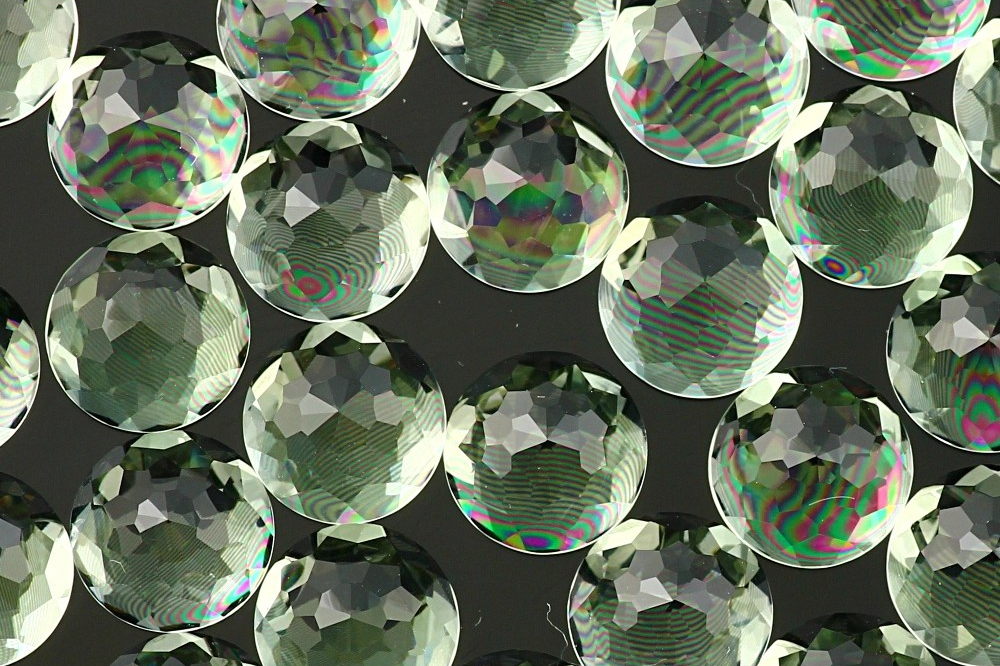
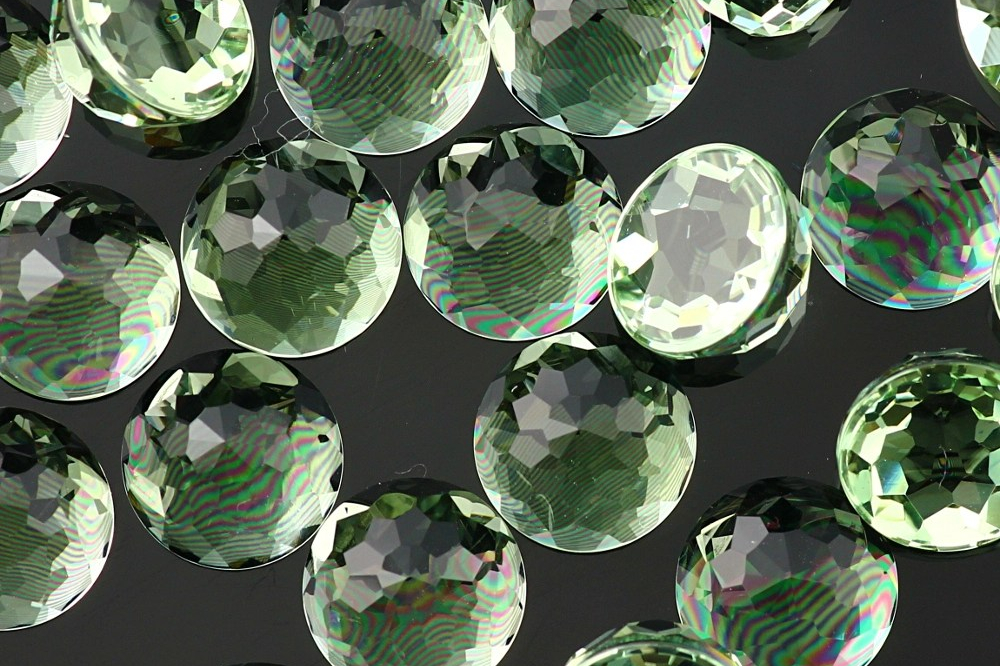
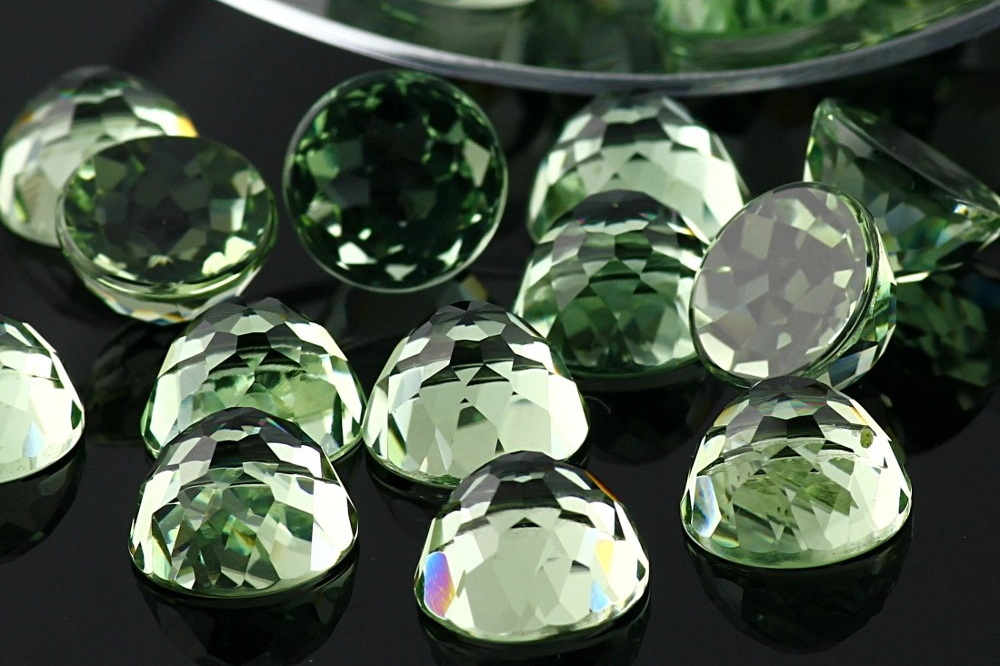
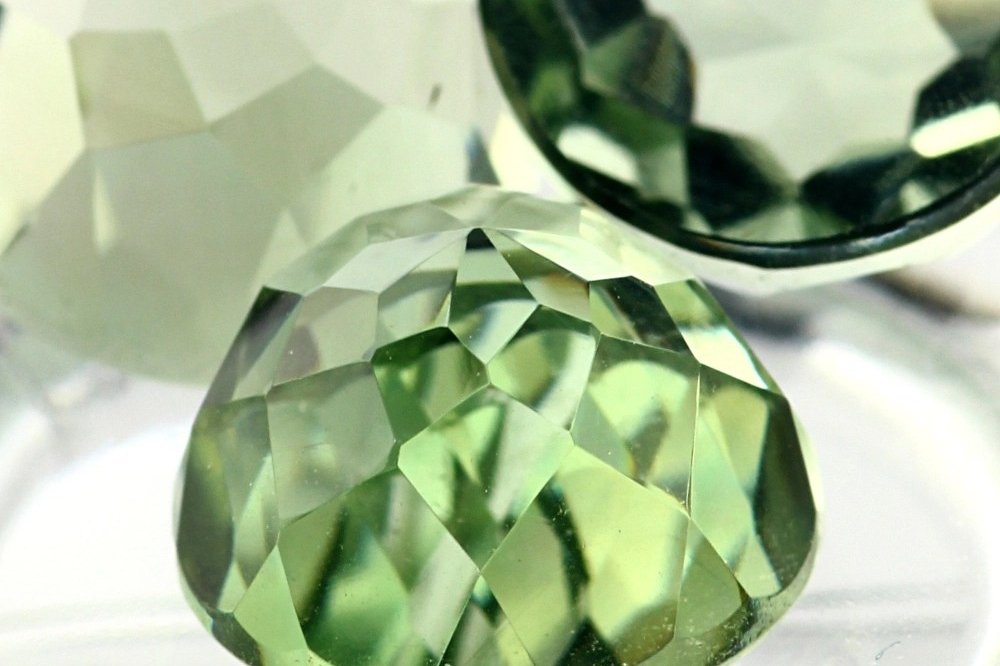
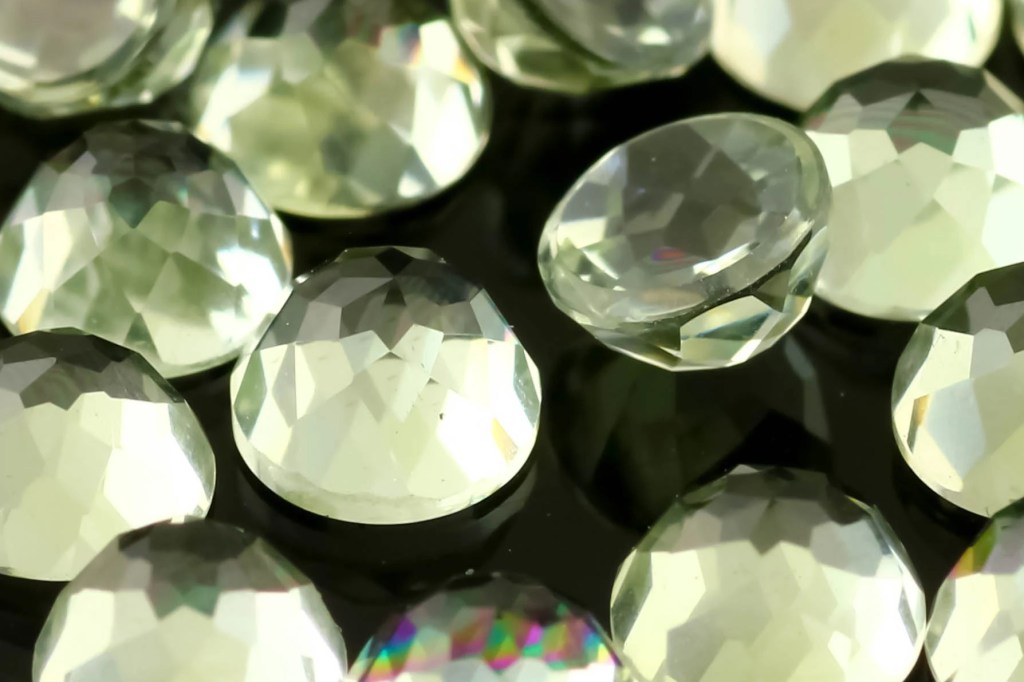
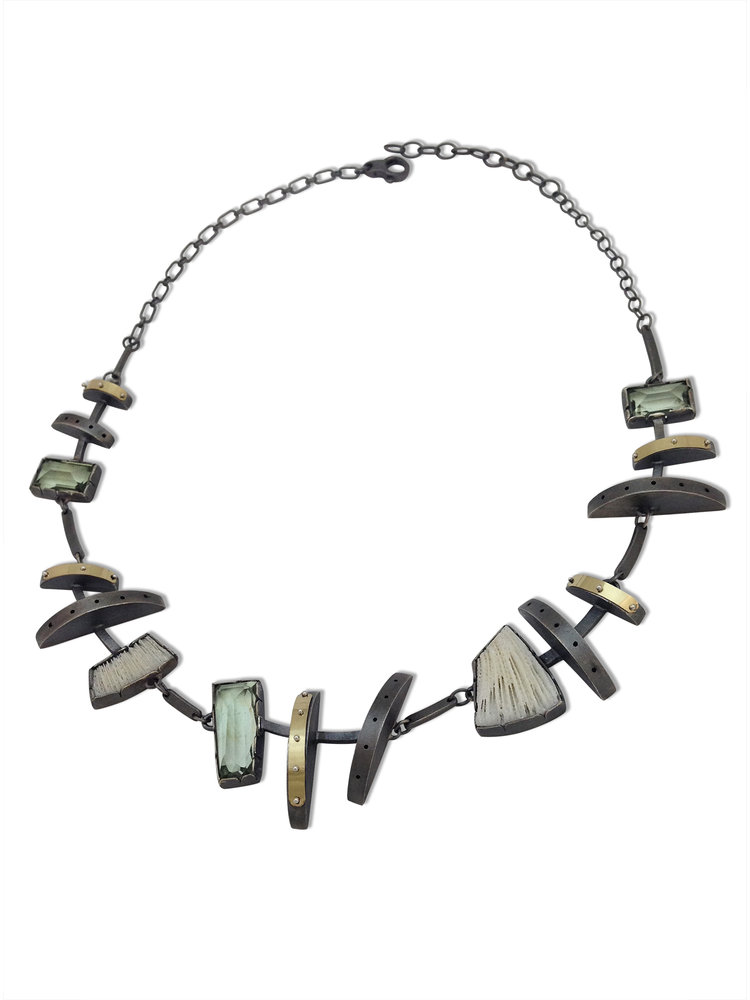
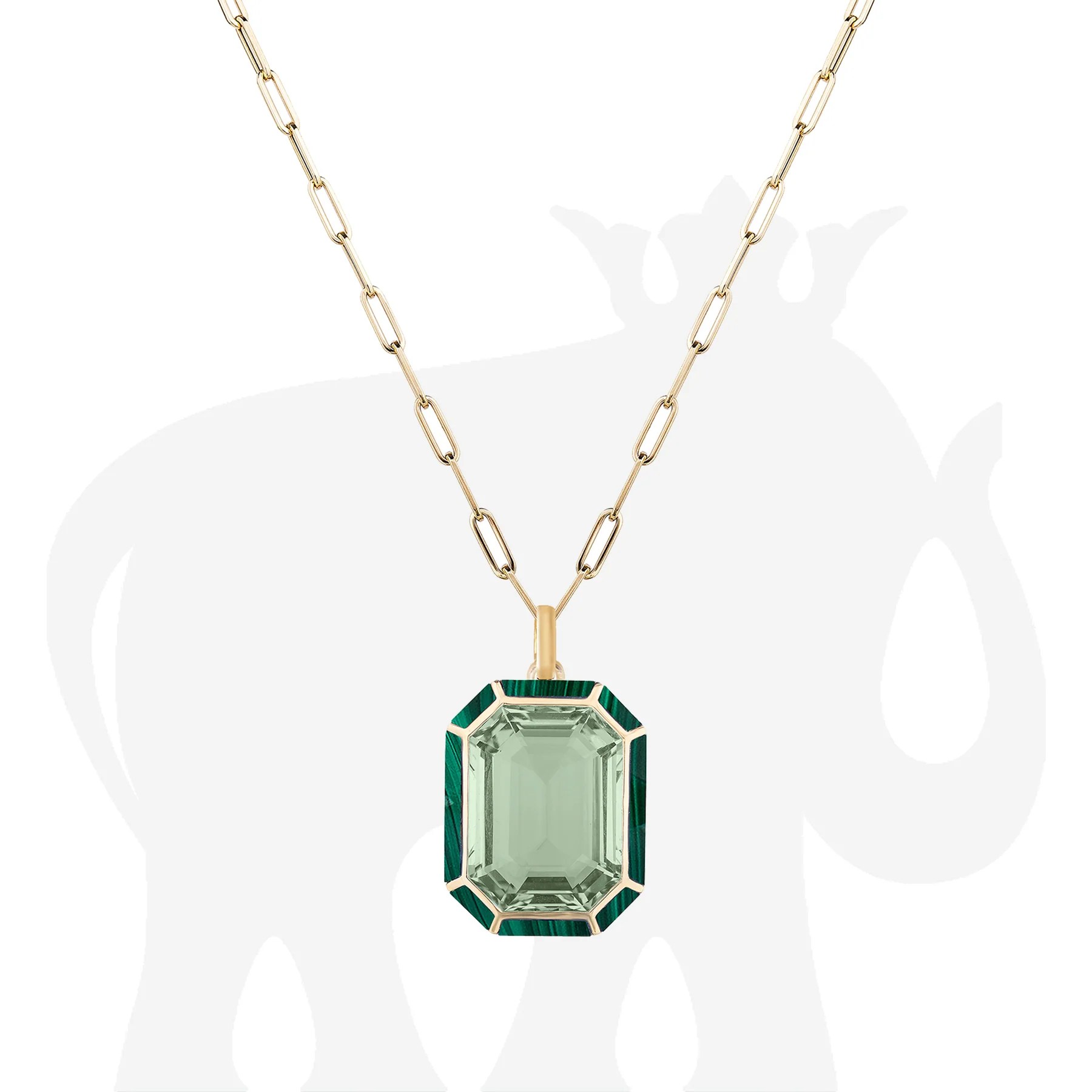
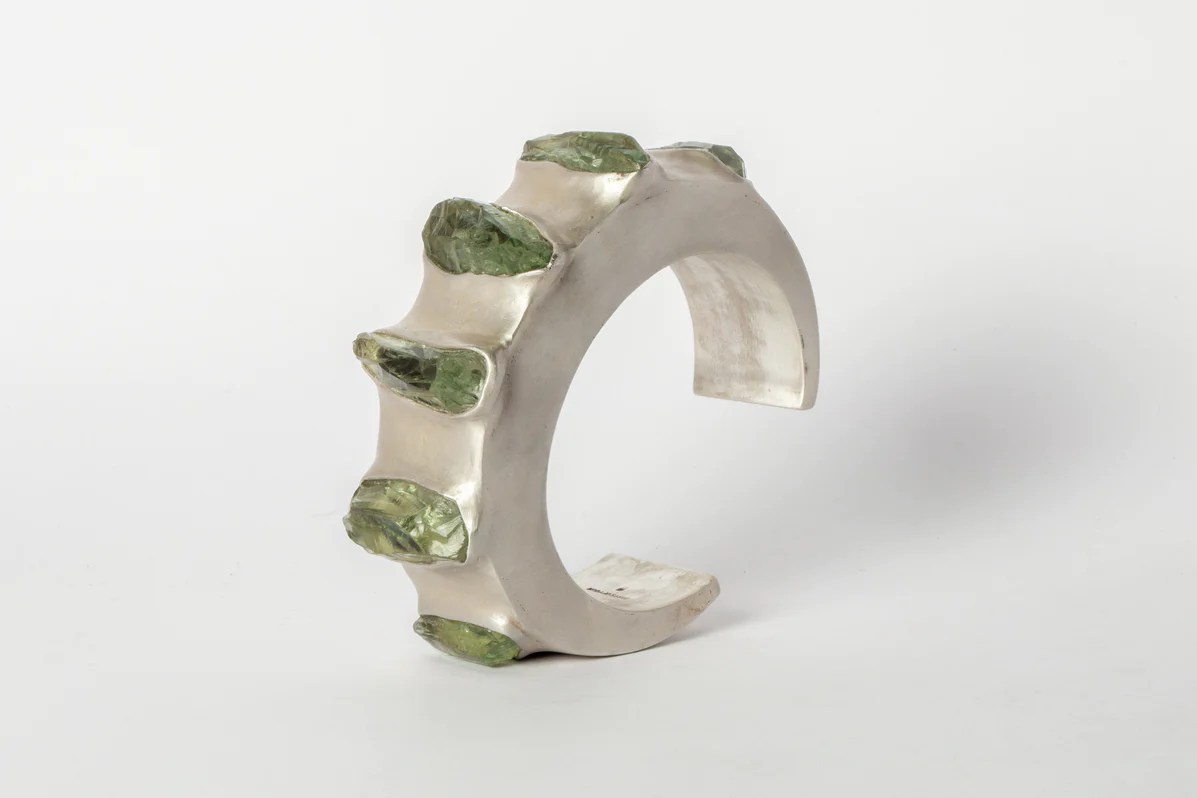
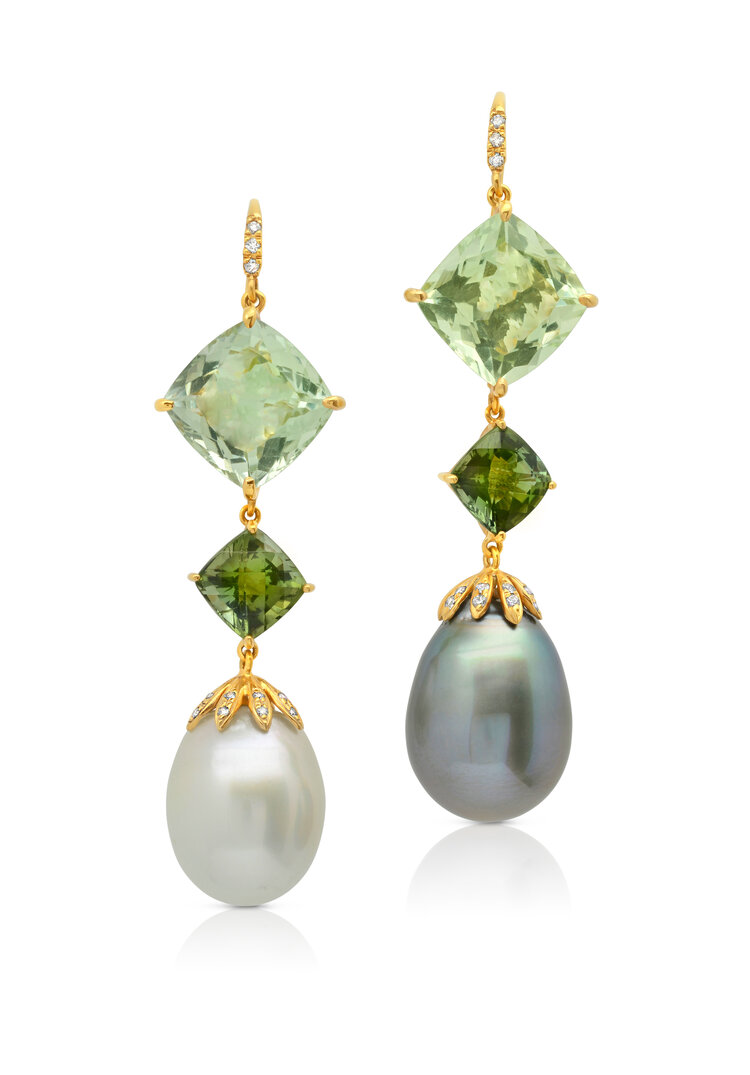
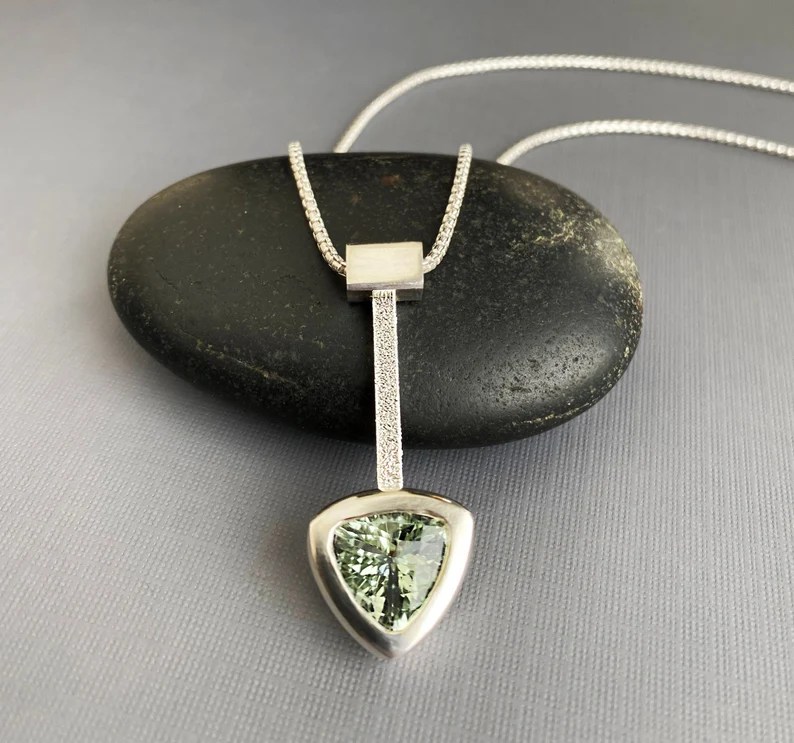
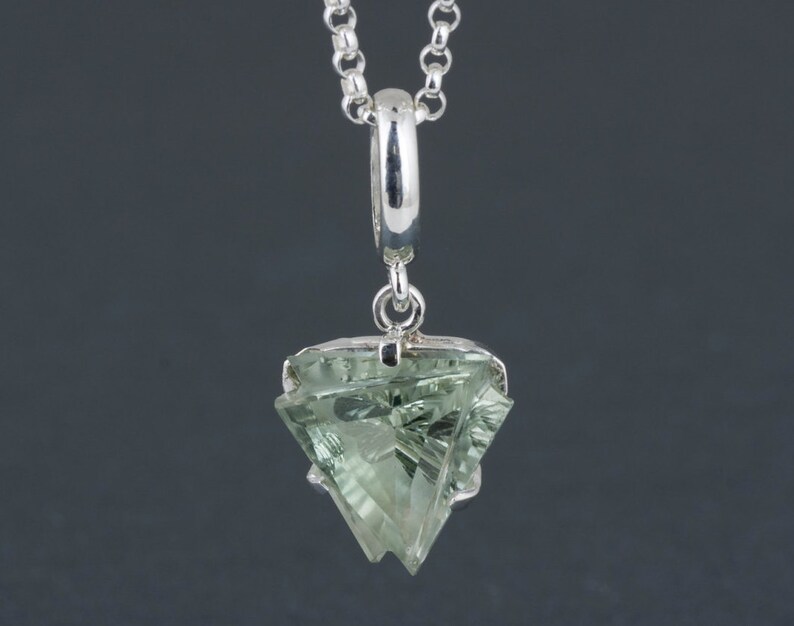
I have noticed a phenomenon over the years, whereby people tend to buy the same stone the same time. It’s not a trend thing and it can only be by chance, but it is noticeable. Like one week, everyone’s at the London Blue and the following week it’s citrine. This week it is the turn of pale, pretty, unassuming prasiolite. When I started out, this used to be called green amethyst, until the Federal Trade Commission called time on this practice, pointing out quite correctly that amethyst came in one colour: purple and so therefore it was a misleading and inaccurate name. So, hence, prasiolite became the name for this stone. Don’t tell anyone but I do sometimes put ‘green amethyst’ in brackets because I’m sure there are people out there who still have no idea what prasiolite is, and certainly you will see this name used a fair bit in the trade. You also sometimes see it referred to as green quartz. It is a particular thing; amethyst which has been heated, and not just any amethyst either. Only amethyst from certain locations will turn green on heating; from some mines in Brazil and a few other places. You can see this with the settings below, from the gorgeous architectural styles of Janine Decresenzo and Parts of Four to the malchite surround of the Goshwara pendant and the pairing of the Joon Han earrings with the yellowish green tourmaline.
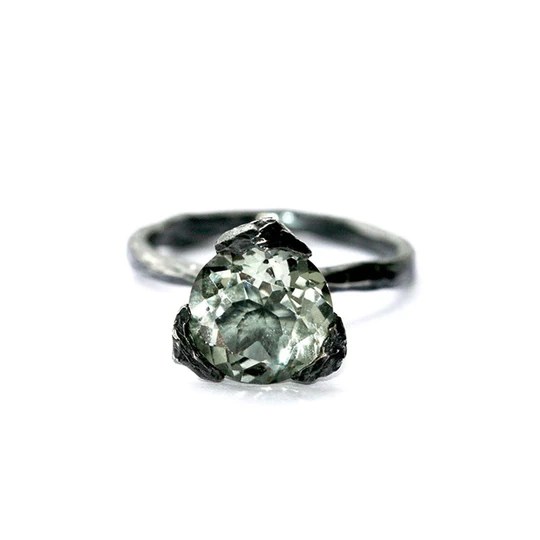
It is, as I say, a rather unassuming stone, so it does deserve a bit of love. It has the splendid clarity you’d expect from quartz, and its colour varies from a light yellowish to bluish green. It can be very pale indeed and as it gets smaller, it gets consequently lighter. I don’t think of it as a centrepiece stone but I’ve seen it used in that way quite a lot recently and what’s great about it is that it is a bit of a chameleon stone – it tends to take on the colour of what it surrounding it, or the metal it is set in. Set it in silver, and it will bring out the cool, almost bluish tones; set it in yellow metal and it will appear more gold. Surround it with darker green to emphasize the colour, or purples and blues to make it look more blue. I like it set in oxidised silver; I think the black does a lot to bring out its colour, as in the Yoki Collections pendant and Hagerskan’s The Cone Ring.
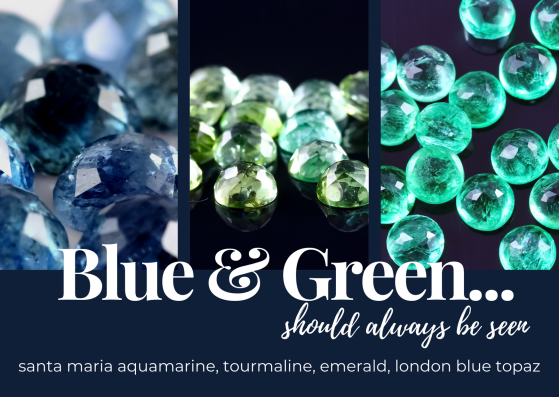
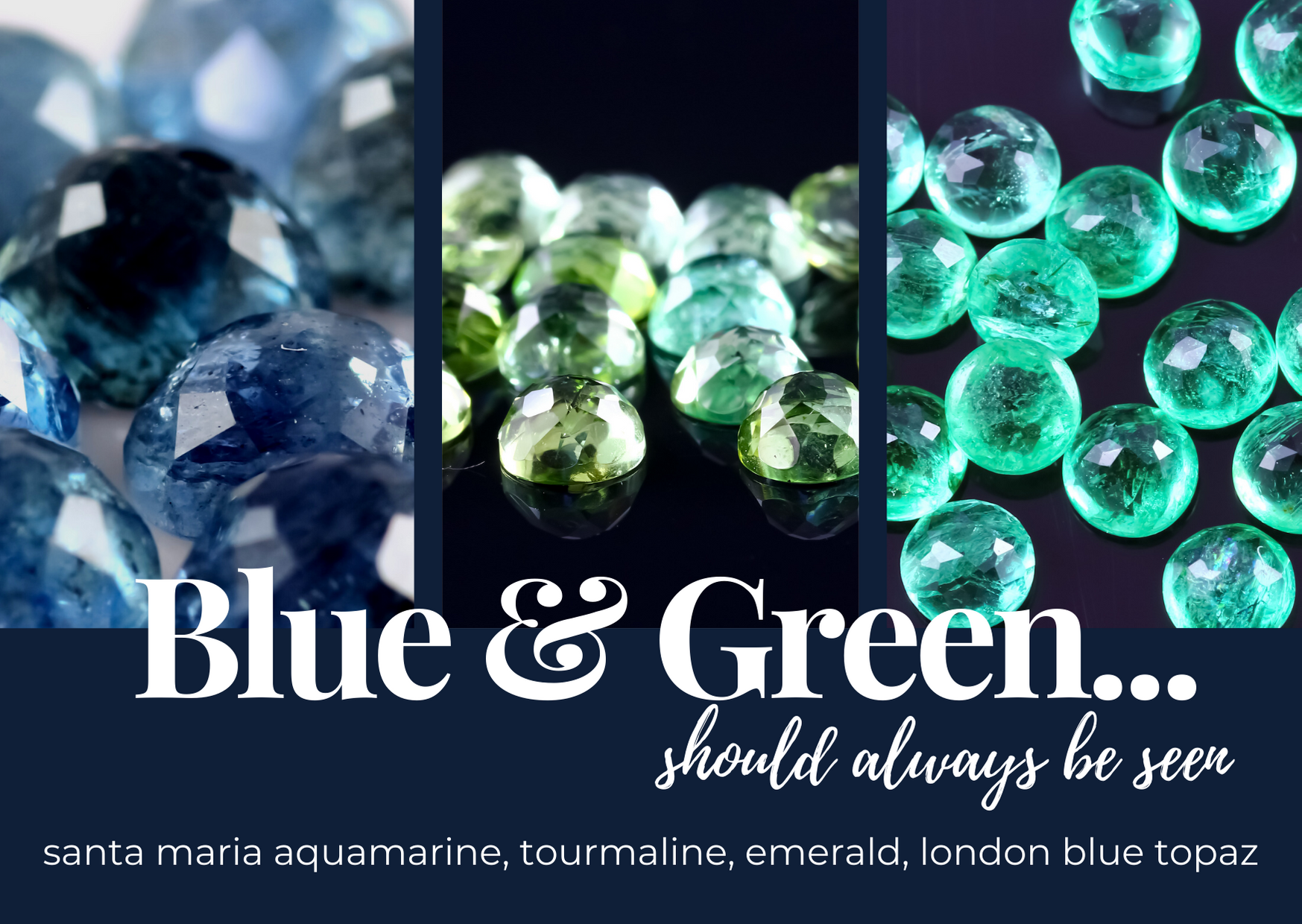
My June newsletter is out and I have a whole bunch of beautiful new stones. The ever-popular Santa Maria aquamarine I now have in an array of sizes and half sizes from 3mm to 8mm, rose cut green tourmaline and emerald, plus there’s free standard shipping for the whole month of June. My newsletter is always the first place to find new stock announcements, offers and sales and sometimes these are newsletter exclusives. You can read this months by clicking here and you can sign up at my website.
Many years ago, shortly after I started out, the price of prehnite went shooting up. It was one of those odd things, where I had to do a bit of a double take. What could be going on? I was told, it was because it was being used as a jade substitute for the Chinese market. I did another double take, because I just couldn’t see it. Prehnite is so commonly pale, fractured, full of wisps and veils that I just couldn’t see how it could possibly substitute for jade. And then they brought out the good stuff; deep green, clean and glowing with an unearthly, dreamlike lustre. Ever since, I’ve tried to stock the better stuff, because when prehnite is good, it’s very, very good indeed. You might never even have heard of it. The GIA thinks not, as they have included it in their ‘Hot Gemstones’ round-up, but that makes it an excellent choice as you are not likely to run into it in your local jewellers. It’s a bit different, unusual and the prices (except for the really fine stuff) are pretty sensible. For meaning, it is best known as the stone of unconditional love, said to connect the head to the heart. It’s found mainly in Australia, Canada, China and the USA, and it’s a good choice for anyone who likes their stones untreated as it never is.
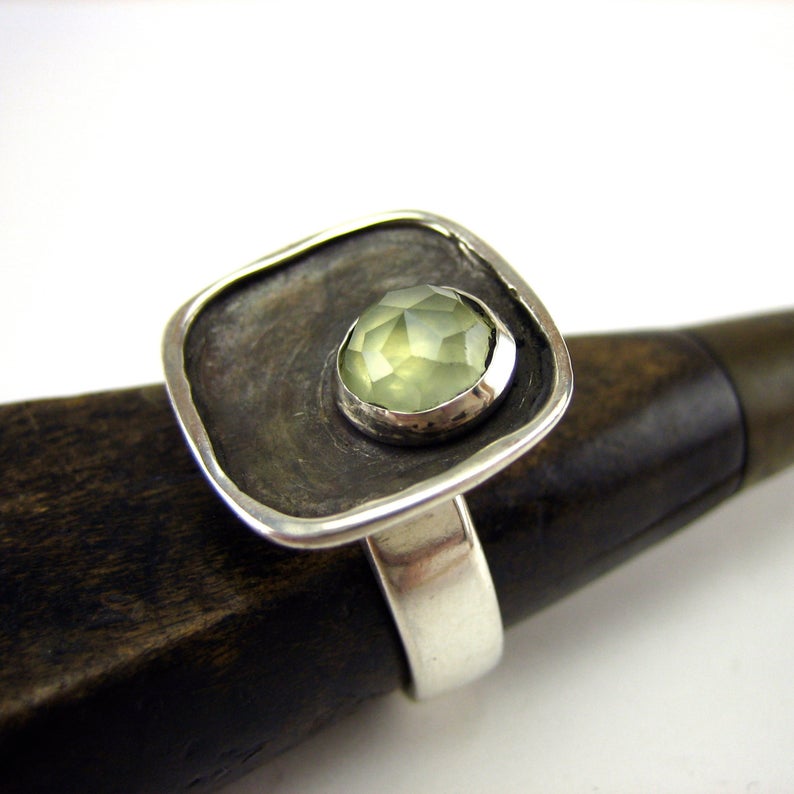
marmarModern Prehnite and Sterling Silver Ring, $130
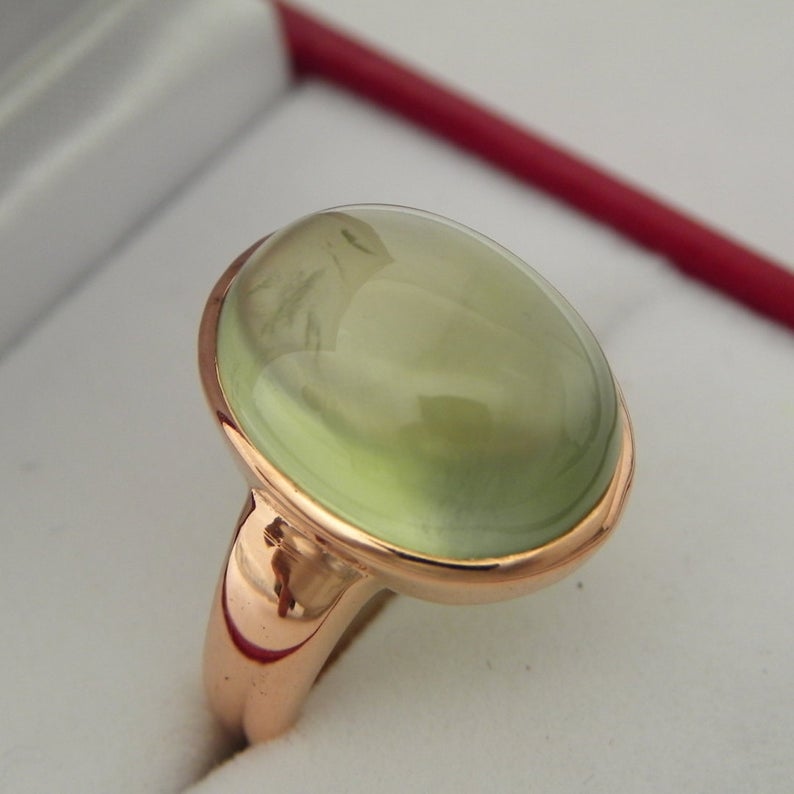
Mastergoldcraft Prehnite and 14k Rose Gold Ring, $875
I’ve just taken delivery of some beautiful quality 6mm rose cuts, lovely saturated green colour, clean quality, $3.75 per stone. You can view them by clicking here. To shop all prehnite, click here.
When I first started selling gemstones 10 years ago (blimey) one of the first stones that I focussed on was London Blue. It was reasonably priced, plentiful and the colour was like no other. Before I started my journey into gems, blue topaz to me meant swiss blue; bright, vivid cornflower blue. I’m not really a bright and vivid kind of girl (!), or at least, the colours don’t look good on me, so it wasn’t a stone I was interested in selling. London Blue, however was a different story. Prussian blue, petrol blue, I had so many names for this distinctive and elegant shade of greenish blue. No other stone could touch it, except perhaps blue tourmaline (indicolite) but you needed deep pockets for that. And my customers appeared to agree! They couldn’t get enough so I started cutting it in all shapes and sizes. However, around 2015 something unpleasant started to happen; the price started jumping up, the quality began to waver. What could be happening? Well, there two main drivers of this price increase. First of all, let’s be clear. When we are talking about blue topaz we are talking about treated topaz. Blue topaz is irradiated white topaz. It has to be irradiated, and then it has to be cooled – that is, allowed to sit whilst the radiation disperses. The darker the topaz, the longer it has to sit. So whilst sky blue topaz has a 3-month cooling period, London Blue has something like 18 months. There are not many places that treat London Blue, and so that in itself puts a pinch on demand. Added to that you have the increasing popularity of the stone, the unwillingness of suppliers to treat more rough – since it effectively ties up millions of dollars for a year and a half with no return during that time. There is also a natural caution amongst suppliers around the popularity of London Blue. Is the increase just a blip, or is it here to stay? Because it’s one heck of an expensive gamble to treat more rough because it is popular now, only to find that in a year and a half it’s gone out of fashion and they have a whole lot of treated rough that they cannot shift. In my view this wont happen; I think the colour is unique and it has enduring appeal, but I’m not the one having to stump up the cash.
However, this is only half the story, and the woes of London Blue go further back, as so many things do, to the recession of 2008. What happened is very simple; topaz is sourced largely from Brazil, and during this time many mines were forced to close. They have never re-opened and now topaz supply is down by around 60% from pre-2008 levels. For a while there was enough rough in circulation to not have too much of an impact, but this corner was turned in around 2015, when demand began to seriously outstrip supply. So there is now a serious problem in that there are two major pinch-points in the supply chain; a lack of good quality untreated rough coming out of the mines resulting in an increase in price at this point. This has then led to suppliers taking a very conservative attitude towards treating the rough, not wanting to tie up increasing amounts of money in a stone that they fear may be something of a bubble. In reality this seems unlikely. Demand for the stone is still high; it is still a unique colour, and it still is available in clean quality. Although the colour has much more variation than it has in the past, with more greyer, less saturated material on the market some people prefer this, feeling that it looks more natural, more gemmy.
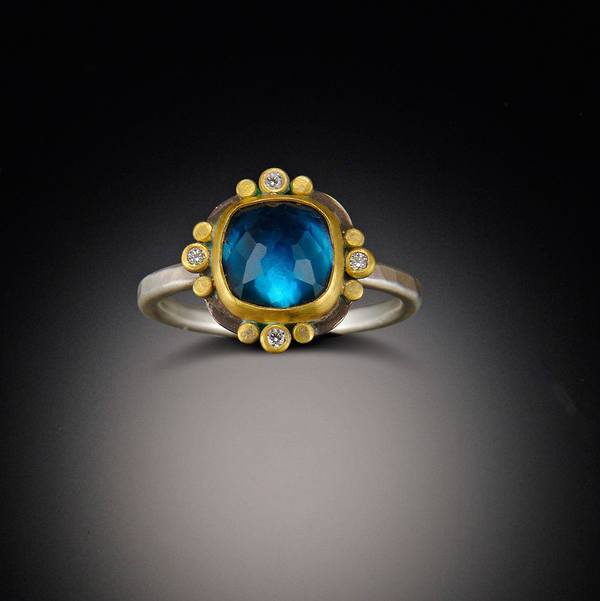
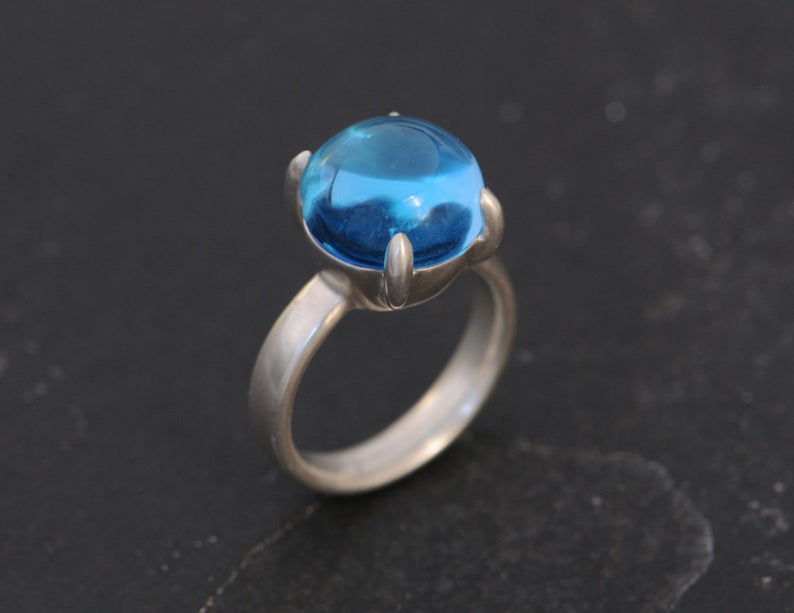
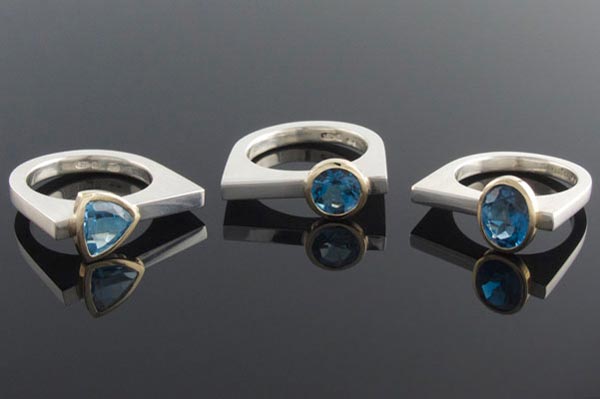
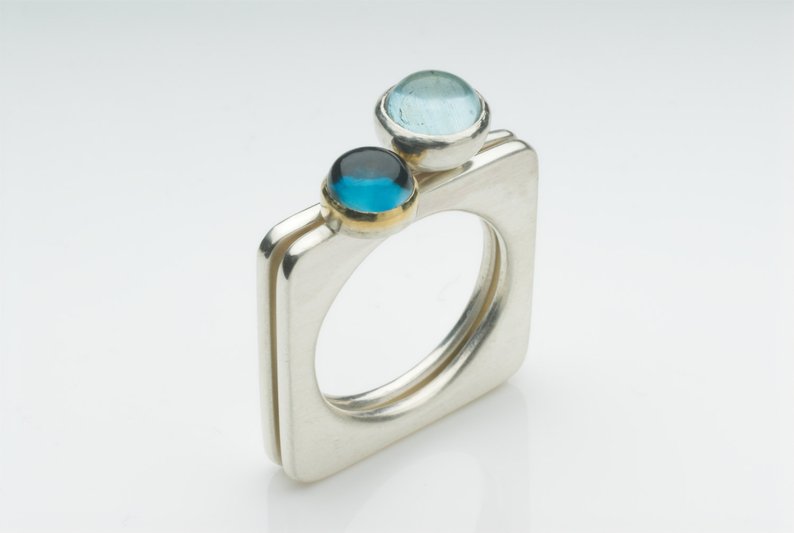
So in short, the outlook for London Blue is that prices aren’t coming down anytime soon. This makes it more expensive to buy, but it also means that it’s unlikely to be a wasted investment. And you could do worse than start here, from top, Ananda Khalsa’s London Blue Topaz ring is set in warm 22 carat gold and sterling silver and highlighted with sparkling diamond dots. I love blue topaz in silver, but putting it in gold takes it to a completely new dimension. I’ve always loved the solid, crafted simplicity of William White’s ring settings; in fact I have a number of stones in my collection I’d love him to set for me. The ring below is a 10mm cabochon in a satin-finished sterling silver band. I do like the angular lines of Eva Dorneys London Blue topaz rings in 9kt gold and sterling silver and I also love the cool stacking system of Barbara S Jewellery. That’s 2 rings, not one; an aquamarine and a London Blue
Barbara S Jewellery Aqumarine and Topaz Contemporary Stacking Ring, $485
I do have new stocks of 6mm London Blue topaz cabochons; they are more expensive than I would like them to be but trust me when I say I have shaved the price as low as possible! You can find all of my London Blue here.
A few years ago I started seeing Super 7 at gemstone fairs. I hadn’t seen it before and I first saw it on the stand of a really fantastic Brazilian gemstone supplier who always has the most sublime quality tourmaline and rutile. Gorgeous clear crystal with bronze coloured needles shot through with smears of bright purple. I had to ask what it was. Super 7, they said. Another gemstone that sounds like car wax (like chrome diopside in my view!). But there’s a really good reason for the name: Super 7 is made up of 7 different minerals. It’s a quartz base with goethite, cacoxenite, rutile, lepidocrocite, amethyst, clear quartz and smoky quartz included. Now this can make for a rather murky stone, however, the whole point of it, the ‘super’ part, the reason it is also called ‘sacred 7’, and referred to as ‘the healing stone’ is that this combination of 7 minerals are supposed to have powerful healing properties. For jewellery, it’s better that the inclusions are a bit more sparing and in fact, it can still be called Super 7 even if it does not include all 7 of the minerals. An awful lot of people have not heard of it, and I do think with such an unprepossessing name it may well stay that way. Names matter, and Super 7 just doesn’t resonate with most people. However, do take a look at it. At its best it’s really special. Below are a couple of really nice examples, both sterling silver and Super 7: left is by Doorways to Power and right by Divinity Jeweler
Divinity Jeweler Sterling Silver and Super 7 Pendant $277.72
Doorways to Power Sterling Silver and Super 7 Pendant $398
To view our collection of Super 7 cabochons, click here
Our September 2017 newsletter is out and we have an absolute treasure trove of new gemstones for you; rainbow moonstone AA rose cuts – for which I’ve been inundated with requests – new opal rose cuts, new turquoise rose cuts, brown moonstone rose cuts, garnet rose cut pears, and so much more. And the best incentive whatsoever to join our email list is a newsletter-only scratchcard discount. We’ve got a number of discounts ranging up to 15%, so everyone is a winner; scratch and see what you’ve won! And if that’s not enough, we’ve got news as well: the introduction of a $3.50 USPS First Class posting option for customers buying from the US store and shipping within the US, and for international customers, the opening of a new Hong Kong Etsy store. So dive in and have a read! Click below for the relevant newsletter! And why not sign up at our websites to make sure you never miss out?!
Our June 2017 newsletter is out and this month we have a fantastic 20% 3 day event! From now until 14th June, you can use code J17D1 to take 20% off your entire order. A fantastic chance to stock up on all of your summer-time requirements, and we have a lot to tempt you this month! All new rose cut pearls, sublimely beautiful bi-colour tourmaline baguettes, rose cut rhodolite and re-stocks of favourites such as turquoise 3mm cabochons. You can view the newsletter here and sign up at joopygems.com; there’s an offer in every issue, so don’t miss out!
I’ve probably used that title before, but it has real poignancy now, as this is the last lot of AAA rainbow moonstone I am going to have for a while, and I may as well look for more at the end of the rainbow, along with the crock of gold. It’s 3mm rose cut round, and when it’s gone, it’s gone, so if this is your thing, grab it now before it runs out. Lovely, clean material with bright blue, green and gold adularescence (flash). I’ve got it in both Hong Kong and US stores: the Hong Kong store has stones with the kite shaped-faceting and the US store has the triangle facets. Why is the AAA so hard to find now (and it is, and if you can find it, it is an arm and a leg jobby)? Well, as usual, it’s a supply and demand thing – people have become more aware of the fine grade moonstone in recent years, and more prepared to pay extra for it. But it’s scarce because of the way moonstone is formed, in many layers. This layered makeup is what gives the stone its classic blue or green flash, as light refracts off the layers and produces that unworldly sheen that appears sometimes suspended within the stone. A layered makeup is obviously going to most commonly produce a very fractured stone; which then interferes with the refraction of light and results in a poor flash. There is absolutely no shortage of this kind of material at all, but the clean material is obviously less common in nature. You can find it here in my Hong Kong store, and here in my US store, $3 per stone each in either store.









 Joopy Gems | The Blog