Our December 2017 newsletter is out and we’ve got a whole lot of news and some fairly significant pieces of information. We also have a long 15% discount on everything from now until early January. You can use code XMAS15 – and it’s a multi-use coupon so use it as many times as you like! Benefit from the new shipping system we have in Hong Kong! To read the newsletter, click here.
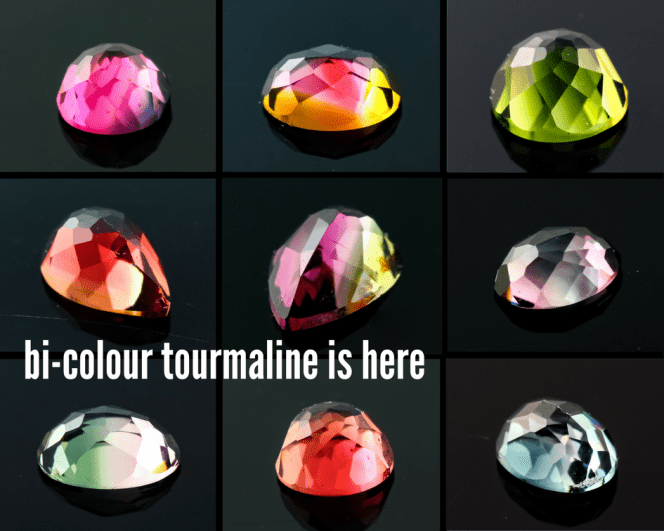
Alot of people were interested in these: calibrated bi-colour tourmaline rounds, ovals and pears. It’s taken me so long to get them listed, and I wanted to have them listed in time for my sale but I didn’t quite, so I’ve extended the sale. If you like these, you can get them on a 25% discount until Wednesday midnight 29th November. The rounds come in 4mm, 5mm, 6mm and 7mm and the pears and ovals in 3x4mm, 6x4mm and 7x5mm. They are all priced according to weight and how good the colour is. To browse the entire collection, click here. Coupon code FIREGEM25 will get you 25% off until midnight, Wednesday 29th November EST.
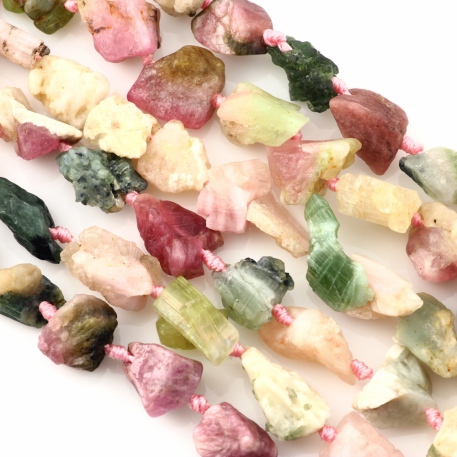
Still available in the tourmaline de-stash are a few of these strands of tourmaline rough beads. All different colours; some bi-, some parti-colours. Strands are 16 inches long and the beads are variable in size, but I would say on average in the 10mm range. They are on a fantastic 45% discount, from $35.50 to $20 per strand and you can find them here.
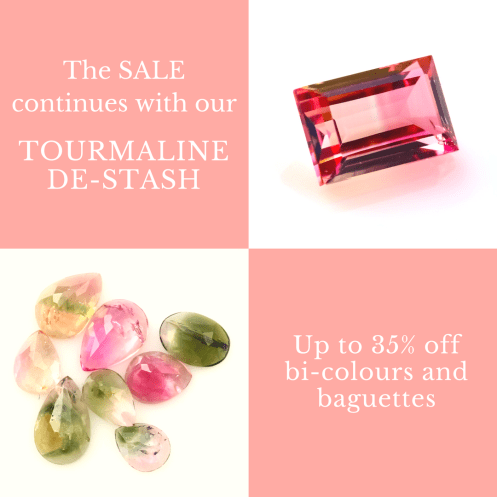
My de-stash sale continues, this time with a focus on tourmaline baguettes and bi- and parti-colour mixes. Up to 35% discount, and these are normal stock items, no seconds. I’ve got a lot of new tourmaline stock coming in November and I’m keen to clear out the old. Keep your eyes out over the next few days as I add more items to this section! Items are mostly only available in the Hong Kong store, but I have a free-shipping coupon running until the end of the month to make things easier: O17FS1
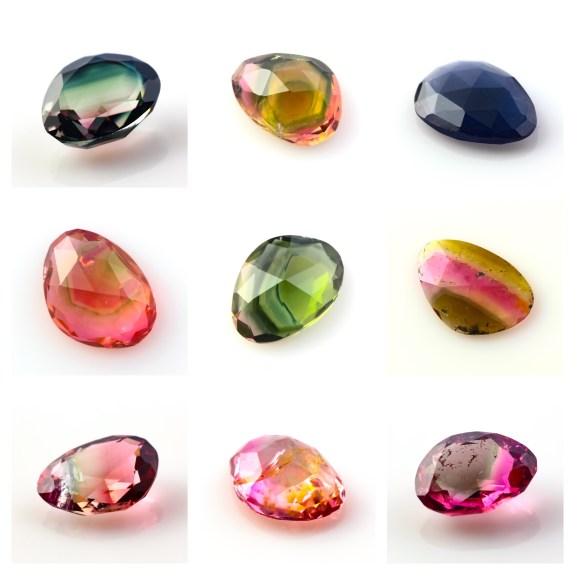
Tourmaline rose cut freeforms; parti-colour and plain
Well, I listed these a few days ago and already they are going fast. Lovely bi and parti-colour tourmaline rose cut freeforms – also known as polki cut, if that makes more sense to you. The fascinating multi-coloured patterns that occur, and that make this material so unique are caused by changes in the concentration of trace elements during crystal growth. It is these trace elements that often give stones their different colours; manganese for red, pink or brown crystals, iron for dark blue or black, chromium for green and so on. As the crystal grows, if it is exposed to different trace elements, it will change colour as it grows. These are always so popular; partly due to their vibrancy, I think but also because they are unique. You can find them here, just in the Hong Kong store.
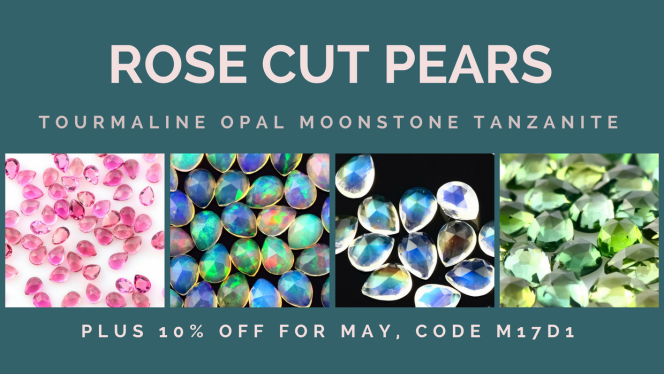
I’m so in love with these: beautiful rose-cut pears in a variety of exciting stones. A while ago I had some 3x4mm rose cut sapphire pears, and they were really popular, but I struggled to replace them, as it’s always a bit difficult finding nice quality sapphire at a price-point that doesn’t make you choke on your morning tea. Then I had a brainwave: tanzanite! The same colour and effect but much more plentiful and at a price that won’t stick in your gullet. I mentioned it to a customer and she said, ‘oh, how about opal? How about rainbow moonstone?’ So I said good plan and went to my supplier who said, ‘Pink tourmaline! Green tourmaline!’ So now we have all of those things. The tourmaline is not going to hang around. I don’t have a lot of it and it’s clean. I’ve already sold a fair amount of it. The tanzanite, moonstone and opal I have plenty of. The opal is very, very powerful. I mean, not in a mystical way; the play of colour is super-strong. It’s white Ethiopian material, so the play-of-colour appears suspended in the stone. The rainbow moonstone is AA grade, so a few wisps and veils but excellent clarity and strong adularescence. The tanzanite is light blue/violet depending on the angle of view, the pleochroic little so-and-so. I’ve got light pink and dark pink tourmaline and it is stunning, and green tourmaline as well which is unusual and which never hangs around long in its rose-cut form. Prices start at $6.10 for a light pink tourmaline stone rising to $10 for a dark pink. Everything else is in between!
You can find them on the Hong Kong site here, and on the US site here.
Our May 2017 newsletter is out and we have a cornucopia of new stock! The big story is the 3x4mm rose cut pears, in fantastic new gemstones, as above but we also have new tanzanite, labradorite, rainbow moonstone in other shapes and sizes and more! You can get the international newsletter here, and the US one here, and you can sign up at either website to make sure you never miss out!
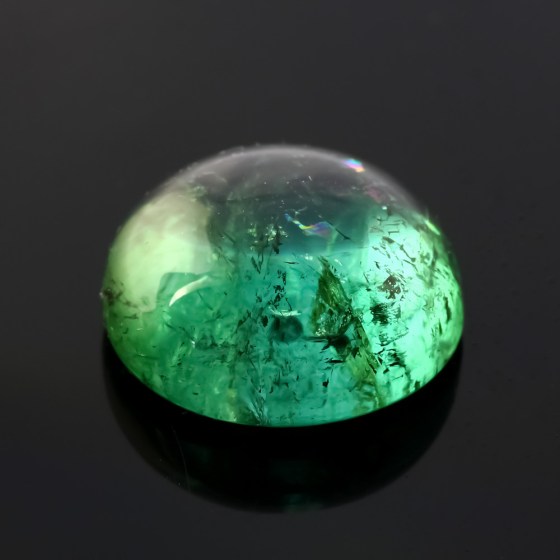
Those of you who know me well know that I love tourmaline. Out of all gemstones, it is simply my runaway favourite, and I value it for its infinite variety; the colour range, the pleochroism, even the fantastic and fascinating inclusions. This is a fantastic 15.1mm round bluish-green tourmaline cabochon – yes it’s all the same stone in the slideshow above but what you are seeing is an example of that pleochroism I was referring to. Tourmaline is strongly pleochroic; that is to say that it absorbs different wavelengths of light depending on the direction of the rays. What that means in reality is that it will show different colours according to different viewing directions. You can see that in the stone above, which shows both green and blue colours, strongly. It’s an absolute beauty.
Now, tourmaline grows in an environment rich in liquids, which are often captured as inclusions during crystal growth. I wish I had a camera on my microscope as when I view this stone, I see a network of tiny thread-like cavities running all over the stone. They are really fascinating and beautiful. In fact, I think that the inclusions make this stone; a fingerprint of its creation. However, as with all of my stones, because I use a macro lens and the stones are magnified beyond their actual size, they always appear far more included in photographs than in reality.
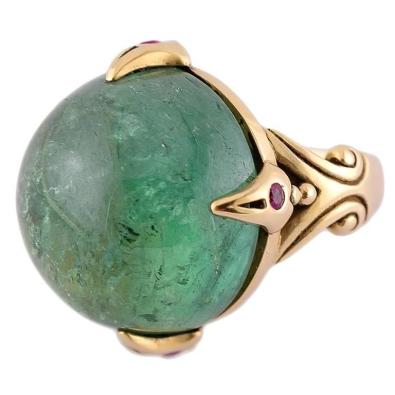
Most blue and green tourmalines derive their colour from traces of iron, and they are sometimes known by the trade names of indicolite for blue and verdelite for green. Less common than pink stones, they are according more expensive and sought-after. This is a strongly saturated stone with open colour, and at 15.1mm round and 14 carats in weight, it is a substantial rock. It’s going to make a fantastic ring or centrepiece for a pendant, something like this one, below. I found it on 1st dibs, and it’s not credited to any known designer, but I love how they have called it a ‘dragon’s eye’, because that’s exactly what it looks like. I also hope it shows just how fantastically beautiful and effective a large, included stone can look. The stone in this piece is a whopping 39.5 carats and both more included and less saturated than my stone but it’s nonetheless an amazing piece.
Be inspired! And do it fast before temptation gets the better of me and I filter the stone into my personal collection! To view this fabulous stone, click here. It’s in my Hong Kong shop, but it ships internationally.
Large Green Tourmaline, Ruby & Gold Dragon’s Eye Ring, $6,885
Out now! Our April 2017 newsletter with news about new stock – labradorite and aquamarine freeforms, plus some amazing concave cuts and lovely new rose cuts pears. Also it’s double points for shopping and introducing a friend via our points scheme – plus your friend will get a 10% discount, so there couldn’t be a better month to spread the love! We’ve got 2 newsletters: the international version and the US version, depending on which shop you use.
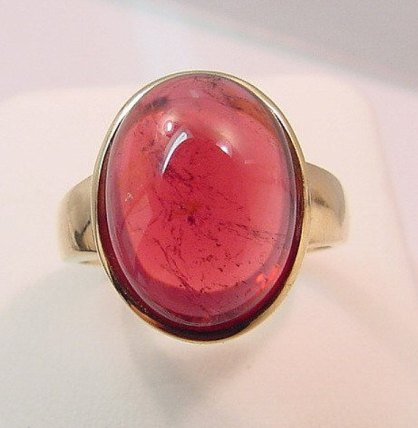
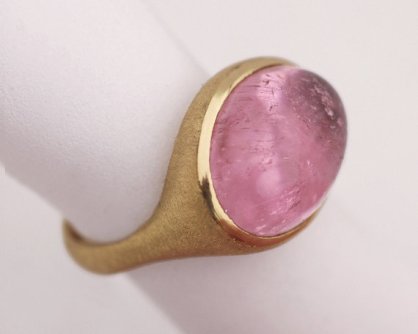
This one is all about the cabochons… A whole new lot of small to medium sized pink tourmaline cabochons. Lots of teardrops. Some ovals. Some marquise. Lots of bright, vibrant fuschia, and nice affordable prices for a lovely unique piece that won’t break the bank. Prices start from $37 with these stones which I think lend themselves very well to pendants. Mix them up with unexpected partners for an exciting effect; sunshine yellow citrine, or sharp green peridot. Perhaps even turquoise or rainbow moonstone could be fun. My mother’s engagement ring is a rather unexpected and lively tourmaline and amethyst combo. Or just go clean and lean with some white stones; diamonds if you can run to them; white topaz if not!
One thing that you tend to get with tourmaline – especially cabochons – is inclusions; very characteristic mirror like-inclusions, two-phase inclusions, liquid inclusions and growth tubes to mention just a few. Because of this, the predominent value factor with tourmaline is colour, and inclusions are tolerated to the extent that they don’t interfere with this. Besides, I think that many of the inclusions you see in tourmaline are quite simply beautiful, and rather than detract, add to the character of the stone. Clean gemstones are desirable, I know, but a few inclusions roots a stone to the earth, tells you where it has come from and reminds you of its incredible and unlikely journey to the surface of the earth. To shop the new tourmaline cabochons, click here.



 Joopy Gems | The Blog