How Do You Solve a Problem Like London Blue?

This slideshow requires JavaScript.

When I first started selling gemstones 10 years ago (blimey) one of the first stones that I focussed on was London Blue. It was reasonably priced, plentiful and the colour was like no other. Before I started my journey into gems, blue topaz to me meant swiss blue; bright, vivid cornflower blue. I’m not really a bright and vivid kind of girl (!), or at least, the colours don’t look good on me, so it wasn’t a stone I was interested in selling. London Blue, however was a different story. Prussian blue, petrol blue, I had so many names for this distinctive and elegant shade of greenish blue. No other stone could touch it, except perhaps blue tourmaline (indicolite) but you needed deep pockets for that. And my customers appeared to agree! They couldn’t get enough so I started cutting it in all shapes and sizes. However, around 2015 something unpleasant started to happen; the price started jumping up, the quality began to waver. What could be happening? Well, there two main drivers of this price increase. First of all, let’s be clear. When we are talking about blue topaz we are talking about treated topaz. Blue topaz is irradiated white topaz. It has to be irradiated, and then it has to be cooled – that is, allowed to sit whilst the radiation disperses. The darker the topaz, the longer it has to sit. So whilst sky blue topaz has a 3-month cooling period, London Blue has something like 18 months. There are not many places that treat London Blue, and so that in itself puts a pinch on demand. Added to that you have the increasing popularity of the stone, the unwillingness of suppliers to treat more rough – since it effectively ties up millions of dollars for a year and a half with no return during that time. There is also a natural caution amongst suppliers around the popularity of London Blue. Is the increase just a blip, or is it here to stay? Because it’s one heck of an expensive gamble to treat more rough because it is popular now, only to find that in a year and a half it’s gone out of fashion and they have a whole lot of treated rough that they cannot shift. In my view this wont happen; I think the colour is unique and it has enduring appeal, but I’m not the one having to stump up the cash.

However, this is only half the story, and the woes of London Blue go further back, as so many things do, to the recession of 2008. What happened is very simple; topaz is sourced largely from Brazil, and during this time many mines were forced to close. They have never re-opened and now topaz supply is down by around 60% from pre-2008 levels. For a while there was enough rough in circulation to not have too much of an impact, but this corner was turned in around 2015, when demand began to seriously outstrip supply. So there is now a serious problem in that there are two major pinch-points in the supply chain; a lack of good quality untreated rough coming out of the mines resulting in an increase in price at this point. This has then led to suppliers taking a very conservative attitude towards treating the rough, not wanting to tie up increasing amounts of money in a stone that they fear may be something of a bubble. In reality this seems unlikely. Demand for the stone is still high; it is still a unique colour, and it still is available in clean quality. Although the colour has much more variation than it has in the past, with more greyer, less saturated material on the market some people prefer this, feeling that it looks more natural, more gemmy.

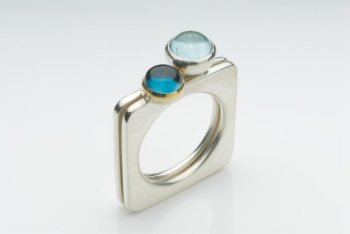
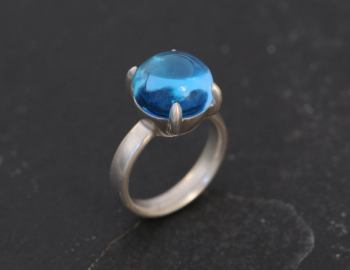
So in short, the outlook for London Blue is that prices aren’t coming down anytime soon. This makes it more expensive to buy, but it also means that it’s unlikely to be a wasted investment. And you could do worse than start here, from top, Ananda Khalsa’s London Blue Topaz ring is set in warm 22 carat gold and sterling silver and highlighted with sparkling diamond dots. I love blue topaz in silver, but putting it in gold takes it to a completely new dimension. I’ve always loved the solid, crafted simplicity of William White’s ring settings; in fact I have a number of stones in my collection I’d love him to set for me. The ring below is a 10mm cabochon in a satin-finished sterling silver band.  I do like the angular lines of Eva Dorneys London Blue topaz rings in 9kt gold and sterling silver and I also love the cool stacking system of Barbara S Jewellery. That’s 2 rings, not one; an aquamarine and a London Blue
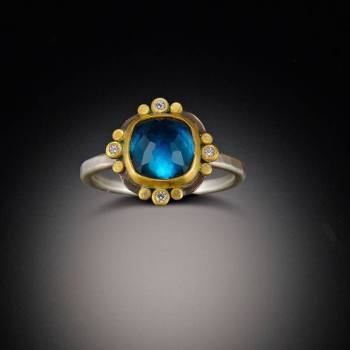
Ananda Khalsa London Blue Topaz Ring with Diamond Dots, $1,190
William White Blue Topaz Cabochon Ring, $594
Eva Dorney London Blue Topaz Rings, $305
Barbara S Jewellery Aqumarine and Topaz Contemporary Stacking Ring, $485


I do have new stocks of 6mm London Blue topaz cabochons; they are more expensive than I would like them to be but trust me when I say I have shaved the price as low as possible! You can find all of my London Blue here.

joopygems.com
Glittering Black Beauty

This slideshow requires JavaScript.

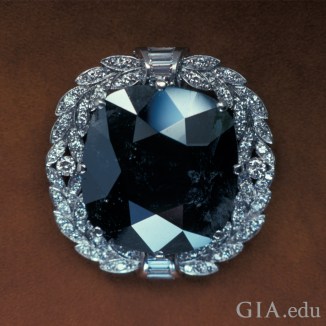
It’s only relatively recently that black diamonds have become prized as gemstones in their own right. Traditionally either thrown away or used solely for industrial purposes, it’s really only in the past thirty or so years that they have come into their own. Now called ‘fancy blacks’, they began their popularity streak when designers started using them to contrast with colourless stones in pave settings and have got bigger and better ever since, in fact you might say they finally ‘arrived’ when Mr Big gave Carrie a 5 carat black diamond ring at the end of Sex and the City 2! Since then, there have been more high-profile black diamond engagement rings and of course, prices have risen in line with their popularity. They are unique stones, having the adamantine brilliance you’d expect from a diamond, despite the fact that they are black and opaque. They glitter, like mirrors, with a silvery lustre. Still, there are relatively few famous black diamonds, one of which is the Black Orlov which comes laden with the usual kind of myths and legends of curse and disaster.

GIA Black Orloff
The 67.50 ct Black Orlov diamond, set in a circle of colourless diamonds (image courtesy of GIA education)

But what is a black diamond? Conversations with customers over the years have told me that this gemstone is not well-understood. Natural black diamond is, in fact, simply diamond that is so included with mineral inclusions, such as haematite, pyrite and graphite that it appears black. It is also often criss-crossed with minute cleavages and fractures that are either stained black or have become black due to graphitisation (the formation of graphite due to a process too arcane for me to wrap my feeble head around). And in fact, a great deal of black diamond on the market is irradiated, so that the inclusions turn black. I always state the black diamond I sell as irradiated, as I am generally not sure and better to be safe than sorry…

The upshot of this is that black diamond is rather brittle, and it is this that causes confusion. Yes, diamond is hard; very hard. But hardness is not the same as toughness. Glass is hard but will shatter if you drop it; putty is soft but you can drop it and it will remain in one piece. Black diamond, filled with inclusions and riven with tiny fractures is pretty brittle. Don’t drop it, don’t – as a friend of mine did – slam it in a car door and do set it with care. You can also expect it to be rather prone to pitting, certainly on the base and around the girdle and often on the facets edges and corners. But if you can live with all that, you’ve got a gemstone like none other. Below, I love the contrast of the black and white diamonds, accentuated by the use of silver and oxidised metals in this Coco & Chia stacking ring set.

Coco & Chia Black & White Diamond Stacking Ring Set
Coco and Chia Black & White Diamond Stacking Ring Set, $265

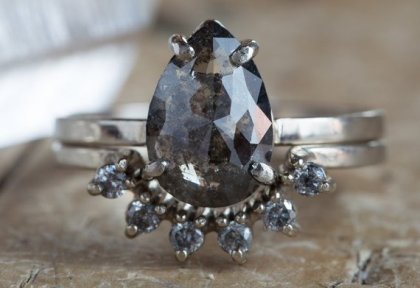
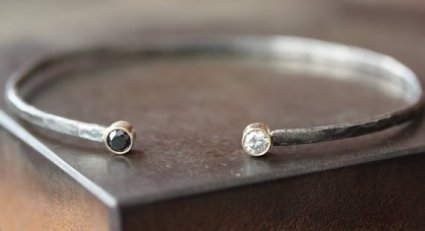
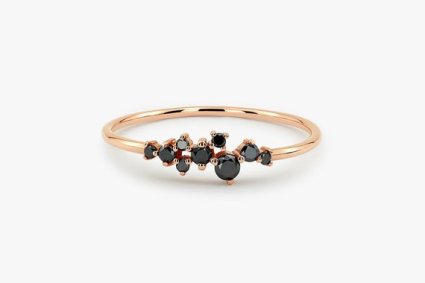
You can clearly see, top, the included nature of black diamonds in this beautiful rose cut black diamond ring from Lex Luxe – you can actually identify the blackened, frondlike clouds of inclusions. Another option from this jeweller is this black and white diamond cuff bracelet, with the contrasting colours offset by oxidised metal. And, right, just because it’s black, doesn’t have to go in white metal; this black diamond cluster ring (bottom) by Ferkos Fine Jewelry is set in 14k gold.

Lex Luxe rose cut black diamond engagement ring
Lex Luxe Rose Cut Black Diamond Cluster Ring, $1495
Lex Luxe black and white diamond bracelet
Lex Luxe Black and White Diamond Cuff Bracelet, $478
Ferkos Fine Jewelry engagement ring
Ferkos Fine Jewelry Black Diamond Cluster Ring, $238.50

At Joopy Gems we carry rose cut black diamonds in a range from 3mm-5mm. These are sized pretty precisely as small differences make a disproportionate difference in terms of price when the carat price is high. The 3mm and 4mm stones are of slightly higher quality than the other sizes but you can expect the odd pit and fracture as is normal with this stone. To browse the entire range, click here.

joopygems.com

Blowing my own trumpet

Processed with MOLDIV

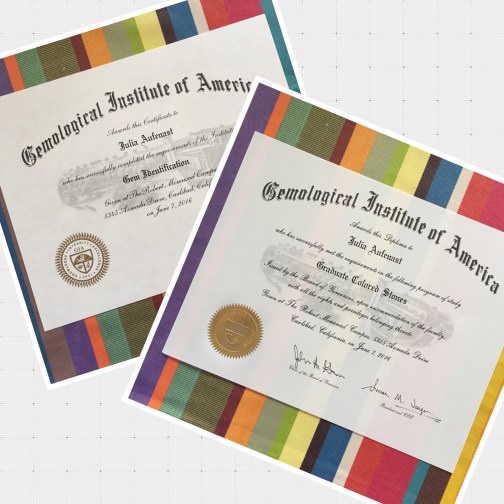
Well, it’s a bit of blowing my own trumpet, but it’s in the name of giving you, my brilliant customers, some extra reassurance. Before the summer, I passed my GIA Gem Identification module, the last part of my Coloured Stones qualification. This was a completely practical, hands-on module, which involved the identification of 500 stones. These came in boxes of 20, posted from the GIA. I had to fill out a worksheet, scan and send back to my tutor in the US and pass each worksheet before moving on to the next one. As you might imagine, this took a little while. One year, to be precise, of late nights, early mornings, scrambled brains and inspiration. I learned so much over this time, not just how to separate different stones, but how to tell a synthetic from a natural, and even what kind of synthetic. This has been especially helpful in giving me confidence to offer precious stones; rubies, sapphires and emeralds. Finally I had to sit an exam, with a proctor approved by the GIA; identify 20 stones. You’ve got 6 hours, and by the way, you’ve got to get them all right to pass. Yes, that’s right; this exam has a 100% passing grade. And I did it! I passed! First time! I am still reeling with joy! So I now have my Coloured Stones qualification and I am starting the last few diamonds modules, after which I will be a fully fledged Graduate Gemologist. Loving my studies!

www.joopygems.com

March Newsletter; new additions, great discount!

Banner March 2016

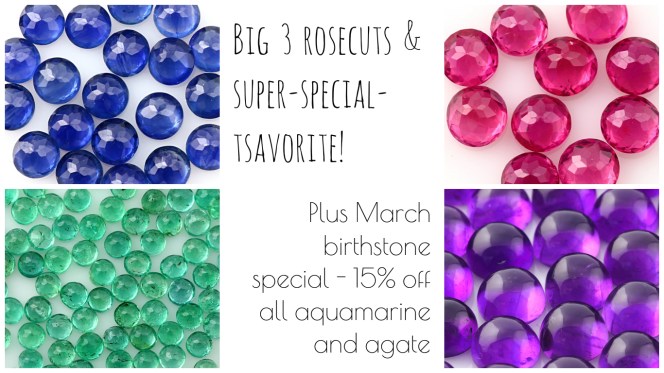
Out now; my March 2016 newsletter with a round-up of new additions, gemstone news and the all-important reader offer – this month a birthstone offer – which I have interpreted very widely, taking in many different birthstone systems and adopting a very loose interpretation, to apply to all aquamarine and agate across my store. That’s cabochons, rose cuts, gemstones, beads and freeforms, all on 15% off for the month of March. Click here to open the newsletter and pick up the discount code, or go to www.joopygems.com to sign up and make sure you never miss out!

joopygems.com