Out now; my March 2016 newsletter with a round-up of new additions, gemstone news and the all-important reader offer – this month a birthstone offer – which I have interpreted very widely, taking in many different birthstone systems and adopting a very loose interpretation, to apply to all aquamarine and agate across my store. That’s cabochons, rose cuts, gemstones, beads and freeforms, all on 15% off for the month of March. Click here to open the newsletter and pick up the discount code, or go to www.joopygems.com to sign up and make sure you never miss out!
JCK news report that something like 36% of Americans want to spend less than $1000 on their engagement rings, and that furthermore, older adults are likely to believe this more than those who are younger. Of course there is (as I know from my other life as a
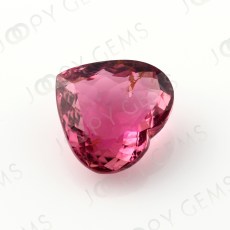
Pink Tourmaline Heart, 5.290 carats, $460
psychologist) that there is often a gap between what people say they believe and what people actually do: the average cost of an engagement ring in the US is between $3000 and $5000. But it made me think – is that necessary? When I got engaged, in the car on the way over to buy the ring, I remember saying to my husband-to-be, ‘Oh, let’s not spend too much, I don’t need anything fancy, it’s not what it’s about anyway’…
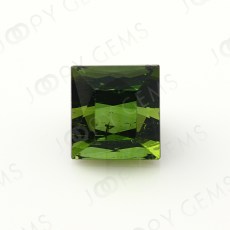
Green Tourmaline Square, 5.415 carats, $565
And then they brought out the trays of bling, and I was ‘Uh…oh… I want that one’!!! And it was more than $1000. More than £1000 come to that. That was before I was in this line of work, and now I’d do it differently. Now I’d work from the stone out – that is, pick a stone that I loved and then have the ring designed around that.
Yellow Tourmaline Oval, 5.165 carats, $450
I’ve got a sapphire in my ring and I love it, but I think if I were to have my time again, I’d maybe choose something different. Forget about diamond, ruby, emerald and sapphire, with the prices sky-high, and having to keep it small. How about the gorgeous apricot pink oval at the top of the page, with gorgeous pleochroic lighter and darker shades? Or what could be more perfect than a big, plump, pink heart to seal the deal? This one (above left) is is around 12x11mm –
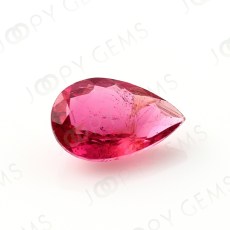
Pink Tourmaline Pear, 1.460 carats, $85
imagine that sitting proudly on your finger! Or for something more classic, the green square mixed cut (above right) would be beautiful surrounded by some baguette-cut diamonds. What I love most about tourmaline is its extraordinary colour range, and more unusual is the gorgeous sunshine-yellow oval, left. Again, it’s a good size at around 11mm long. Also lovely is the luminous pink pear, right, also a great size at around 10mm, and an even more fantastic price.
But what about a ring for $1000 and under? Impossible?! Not at all; there is plenty on offer; so many I had trouble picking just a few. Here are some of my favourites; clockwise from top left: rhodolite garnet is a beautiful and under-rated stone, in my opinion. This garnet, palladium and rose gold ring by Nodeform Weddings is beautiful in its simplicity and the rhodolite and rose gold compliment each other perfectly and comes in well under budget at $785. Those who know me know that there is a special place in my heart for textured metal; Stone Fever Jewelry’s Moonscape ring features a green tourmaline on a hand-punched, cratered 14 carat rose gold band and sneaks under the bar at $999. They will can also make matching wedding bands.and this style can also be made in yellow gold. Doron Merav’s Leaves engagement ring of white gold set with diamonds showcases an unashamedly feminine yet contemporary aesthetic, and at only $370 represents fantastic value for money. I don’t think I’ve seen anything so pretty that I’ve like so much in a long time. Last but not least is Nangijala Jewelry’s rough teal, sapphire and rose gold ring; sleek, contemporary and original. This is priced at a very reasonable $825.
As for me – the ring we ended up buying, the one I absolutely had to have? I remember saying to the rather austere assistant (with the brutal dark red lipstick) ‘My only concern is that it’s quite like Princess Di’s.’ Without missing a beat she replied, ‘Princess Di’s was much bigger.’ Well, I could have walked out there and then. But then, I absolutely had to have that ring.
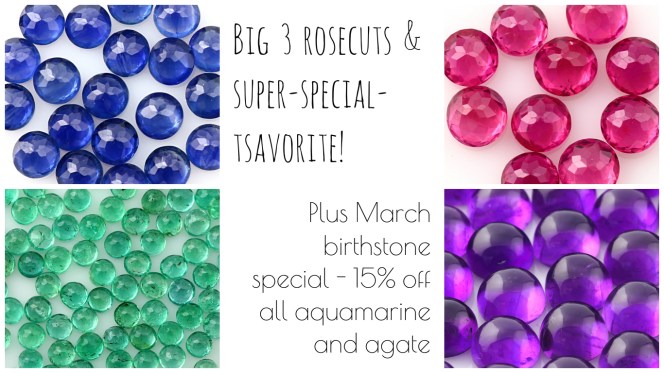
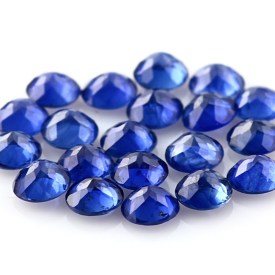
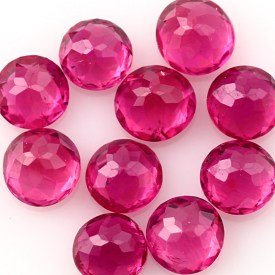
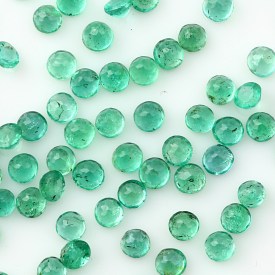
Otherwise known as the Big 3. The stuff of magic. Ruby, sapphire and emerald. This tends to be material that I have for a while then scrabble around trying to replace because it’s hard to find in nice quality at the right price. But it’s always really popular – and I am really excited to have just listed these – 3mm rose cut ruby, emerald and sapphire. The ruby is a deep pinkish-red and is $24 per stone; and good news, it’s from Mozambique, so can be sold to US customers (unlike Burmese material). The sapphire a deep, cornflower blue, and $13 per stone. Both of these have some inclusions, which I viewed under my microscope; fingerprints tiny included crystals and some evidence of heat treatment, as is very common with corundum, both ruby and sapphire. The sapphire also has some angular colour zoning, not very obvious. Now I know that clarity is the holy grail for many people but for me, I am always glad to see a bit of the included crystals and fingerprints, as well as the angular colour zoning, because it helps me to see that what we have here is natural, as opposed to synthetic material. Most exciting of all, because I’ve never carried it before, is the rose cut emerald. It’s a nice shade of quite light blueish-green, quite strongly bluish. As you tend to expect with emerald, it’s quite included with parallel needles, crystals and liquid inclusions. I’m also seeing some evidence of fracture filling and indeed, I would be very surprised if it were not as some 95% of emerald is fracture filled, either with oil or resin. However, the stones are small and the clarity appears pretty good to the naked eye, with nice lustre. The emerald is $8.75 per stone.Now, I don’t have many of any of these except the emerald, but I will be getting more. To shop the 3mm rose cuts, for sapphire, click here, for ruby, click here and for emerald, click here.
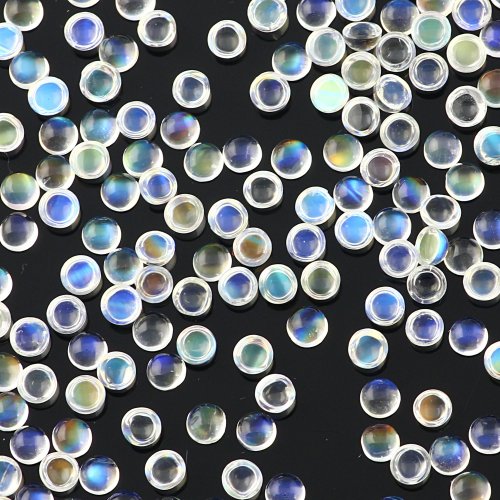
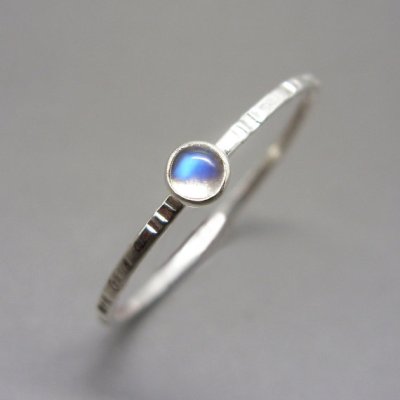
It’s so hard to keep this material in stock. 3mm rainbow moonstone cabochons, clean quality. I also try not to run out of it, and re-order before it’s completely gone, but then someone comes along and buys up the entire stock, and we can’t find the rough and before I know where we are, I’m out for months! Anyway, this is the first of the 3mm and 4mm restock – plain cabochons, now $1.55 per stone. There’s so much of the cloudy, fractured material about, that when you see a clear stone with bright adularescence (or flash) it can take your breath away. In fact, a customer said to me just yesterday, having received her stones ‘is this real?’ Because the extreme, billowing flash can have an almost unreal appearance. It’s truly astonishing. (Answer, by the way, is yes, it is real. As far as I am aware, this is not synthesised at all). Harder and harder – and very expensive – to find in larger sizes, I can still just about put my hands on it for smaller sizes. Now, I’m not a fan of AAA etc grading systems as it is so subjective, and not standardised, but I do use it for moonstone as I carry such a wide range of qualities. This is AAA material, and for that you can expect clean stones with great adularescence. As for what to do with it, below is a lesson in perfect, understated elegance from one of my lovely customers. This sterling silver and rainbow moonstone ring from Brightsmith features a 3mm moonstone on a narrow, hammered silver band, $28.
To shop 3mm AAA cabochons, click here; to shop all my AA and AAA rainbow moonstone, click here. To shop my entire range, click here.
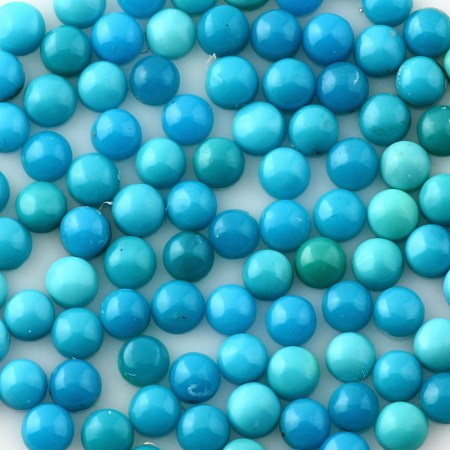
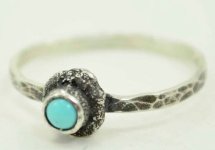
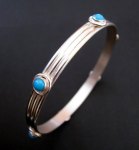
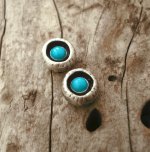
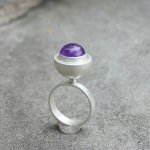
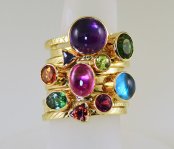
Now back in stock, ever popular 3mm turquoise cabochons! These are one of the (actually many now) stones that I struggle to keep in stock. This material is light greenish-blue with a bit of a colour range going from a bit more green to a bit more blue – do shout if you have a preference. It’s stabilised, as is very common with turquoise, but not dyed. There’s a bit of matrix on the underside of some of the stones, but not across the top and hey, at least you know it’s real! It’s pale tan matrix, so for those of you who are interested, this tells you that the turquoise formed in sandstone. Now, turquoise is quite strongly linked with the ‘southwestern’ style of jewellery, but it also lends itself very well to smaller, sleeker designs, and works equally well with both silver and gold. For inspiration, below are some examples of small-scale, perfectly formed turquoise jewellery. From left: Holly Presley’s turquoise ring features a 3mm turquoise sitting on an organic drop of silver; Rita Moehler’s sterling silver turquoise bangle features six turquoise stones on a solid silver ridged band; Melanie Casey’s set of 5 gold stack rings features 3mm and 4mm turquoise stones (and one green chalcedony!) set in solid 14k gold and Thalassa Jewellery’s silver pod earrings feature 3mm turquoise stones set in oxidised silver pods.
To shop 3mm cabochons, click here; to browse all turquoise cabochons, click here.
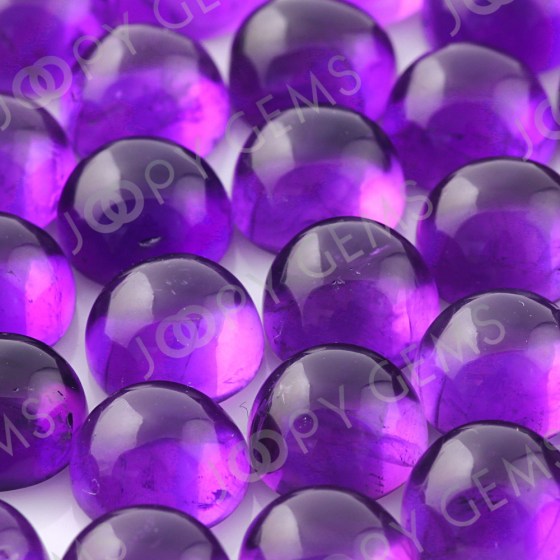
Sometimes I can’t believe all the stones I have. And sometimes I can’t believe what I don’t have. Like today, listing for the first time plain African amethyst 8mm cabochons. Well, I say plain, but these lovely, velvety-dark purple stones need nothing fancy to set off their beauty and in fact will work equally well in a sleek, clean setting or a something more complex. Some inclusions on these stones, as is common with this material; a bit of colour zoning, wispy veils and some crystals, but the colour is dark enough that it’s not obvious. $11.50 per stone; to check them out, click here. To shop all African amethyst, click here.
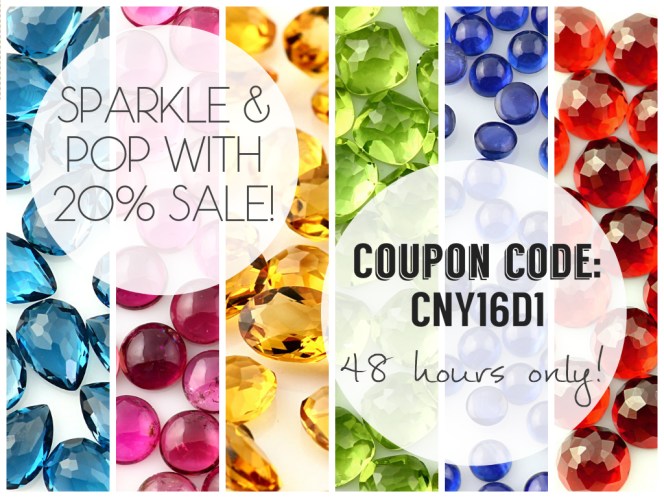
Ring in the Chinese year of the monkey with our special 48 hour sale. A fantastically cheeky 20% discount on all products, valid from now until midnight on Wednesday 10th February! Coupon code below, valid for www.joopygems.com
It’s out and it’s on time for once!! My February newsletter with a round-up of the latest additions, some interesting news and articles, the exclusive newsletter offer, and what to look out for next month. Click here to read the newsletter, and why not pop over to www.joopygems.com to sign up and you’ll never miss out again!
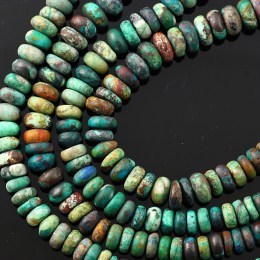
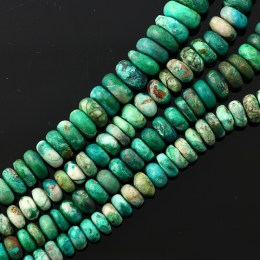
It’s not the most well-known gemstone, but Chrysocolla is endlessly fascinating, with its patterning and array of different colours. It’s the copper in it that is responsible for the vivid blue-green colours and it often combines with other copper-bearing minerals which give it its unique mix of colours and characteristic mottled patterns, such as turquoise, blue azurite and malachite. Just listed I have these gloss finish 7-8mm rondelle beads, at $20 per strand. These are B grade, and I think that the range of colours, textures and patterns on these stones are just amazing. I also have these in a matte finish, same size, which are equally multi-coloured, but with an amazing soft and silky finish (see left). These are also $20 per strand. And finally, some AB grade beads, which are much more uniform in terms of colour leaning firmly towards the blue-green end of the spectrum, again same size. These are also matte finish, and these are $37 per strand. I can see these looking great with some chunky silver accents – let your creativity go wild! Beads are a relatively new venture for me, and all of the ones I have are funky and wonderful – to check out the full range, click here. To shop check out Chrysocolla beads click here.
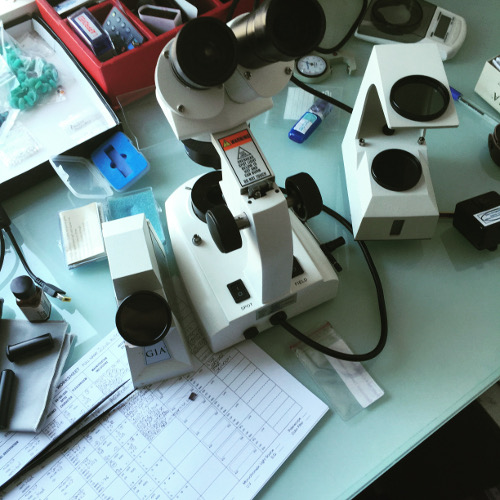
It’s gem ID day today, and that means polariscopes and microscopes; dicroscopes and spectroscopes; loupes and colour filters and not forgetting my personal favourite – and arguably the most important piece of kit; the refractometer. Why all this? Well, as some of you may know, I have been working towards Graduate Gemologist status with the GIA, and I am currently on the Gem Identification element of the course. This is entirely practical and involves the correct identification of 500 stones. Yes, 500! Fortunately they come to me in neat little boxes of 20 and I am currently 400 stones through the course! Then at the end of it I sit a 20 stone exam which requires 100% pass. Definitely not for the faint-hearted, and it’s been a struggle finding the time to do it on top of running the business. But it’s been amazing so far and I’ve learned so much; it’s great to be able to not only separate one stone from another, but to be able to separate natural from synthetic and identify even what kind of synthetic, as well as treatments such as heat and glass-filling. I feel really confident now, and the main barrier to me stocking more precious has been removed. After this I justt have to do a couple of diamond modules and I should be a fully paid up GG with the GIA! The end is in sight!










 I also have these in a
 And finally, some